What do Brazil's new AI rules change in schools?
Brazil's Ministry of Education approved guidelines for AI use at every level of education. What the rule forbids, what stays with teachers and the 12-month deadline.
Picture a student who writes an essay carefully, revises it twice and hands it in feeling satisfied. Weeks later, the school calls them in because a program claimed the text was written by artificial intelligence. There’s nothing else beyond that screen. Who decides what happens now?
That scene is hypothetical, but the question is real, and it’s the one Brazil’s new Ministry of Education (MEC) guidelines try to answer. An automatic AI-text detector is a program that tries to guess whether a machine wrote a text. It analyzes the words and returns a guess. A guess isn’t proof.
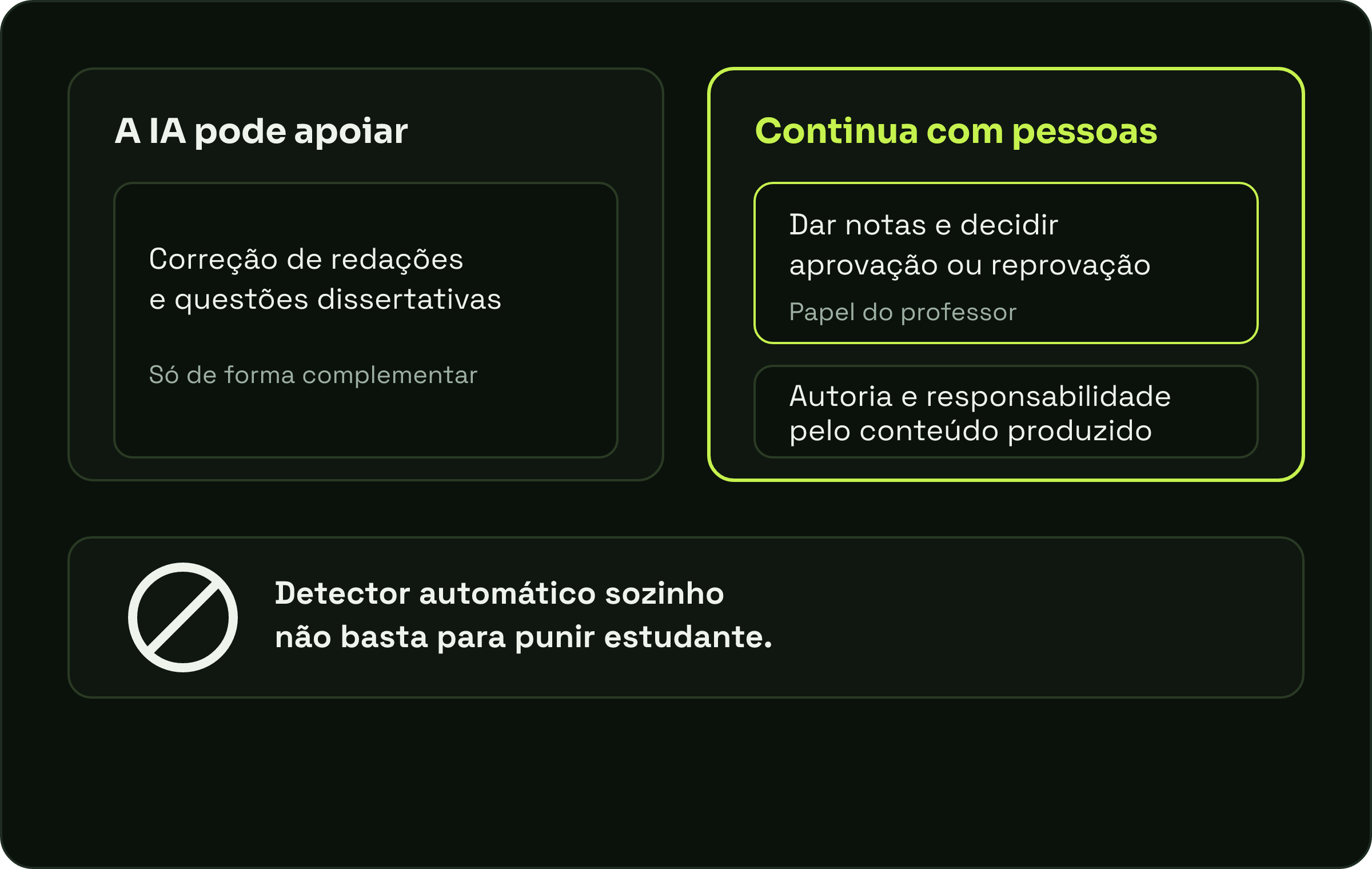
The central point is this: schools and institutions cannot rely solely on these detectors to punish students, according to ne9. The tool can be part of the conversation, but it can’t be the only reason for a penalty.
How we got here
The story has dates and numbers. On Tuesday, November 10, 2026, the MEC ratified an opinion from the National Education Council (CNE) with guidelines for the use of artificial intelligence in Brazilian education, according to Agência Brasil. Resolution CNE/CP No. 1, of November 11, 2026, formalizes the text. A statement republished by Sieeesp says the resolution was published on the MEC website on November 12.
Some reports say the MEC “approved” the text rather than “ratified” it. The dates also vary between November 11 and 12, depending on the source. Here I follow the sequence in the most detailed sources: ratification on the 10th, resolution dated the 11th and publication on the website on the 12th.
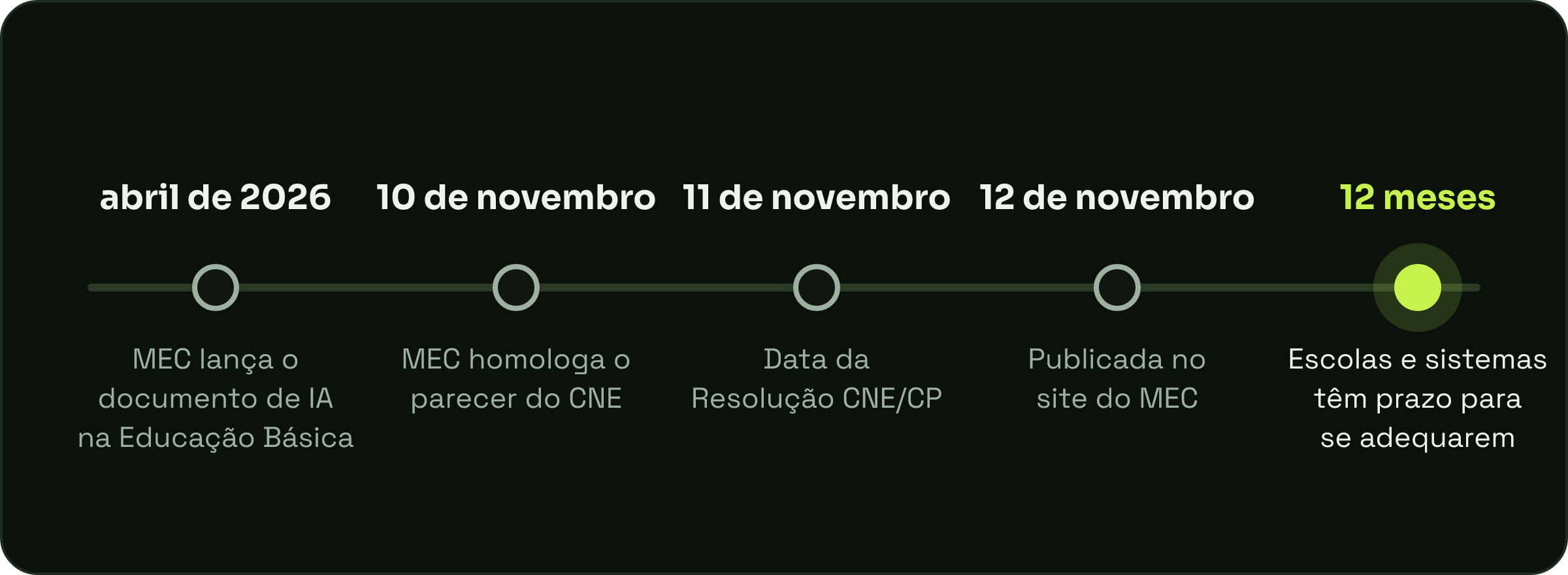
The text didn’t come out of nowhere either. According to Undime, the association of municipal education leaders, it was drafted by a joint CNE committee, with technical meetings, a public hearing and input from experts, institutions and organizations. In April 2026, the MEC had already released the document Artificial Intelligence in Basic Education, with curriculum guidance and principles for ethical use.
Who stays responsible
Perhaps the most important part is this: using AI does not transfer authorship or responsibility for what is produced to the technology, says the MEC itself.
For teachers, the rule is direct: grading and deciding who passes or fails stays exclusively with them, according to Agência Brasil. Council member Celso Niskier, one of the rapporteurs, said the goal is to ensure conscious use of innovation. Education Minister Leonardo Barchini said AI should expand human capabilities without replacing the responsibility and authority of professionals, according to Undime.
When grading essays and open-ended questions, AI can only be used in a complementary way, reports Gazeta de Rio Preto.
Four risk levels
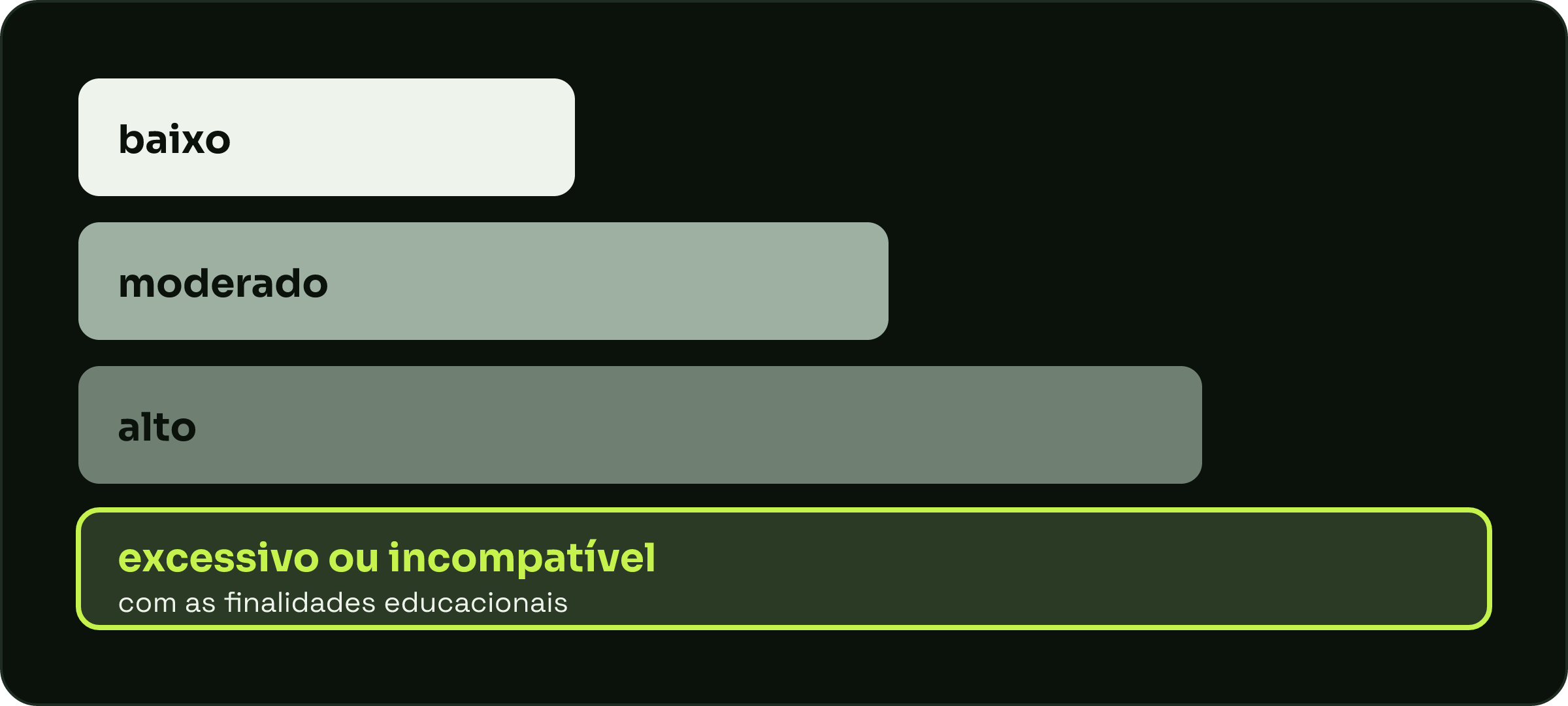
The document classifies AI applications into four risk levels: low, moderate, high and excessive or incompatible with educational purposes, according to ne9.
It comes with a glossary of AI terms applied to education, according to Jornal Passaporte. The text also recommends digital literacy, so students understand how AI systems work, according to Agência Brasil. In simple terms, algorithms are the recipes a computer follows to decide something.
And at each level?
Here I have to be honest. The reports don’t agree on every detail by level, and I still haven’t been able to open the official PDF of the resolution, which is on the CNE website. So instead of stating rules as fact, I’ll show where the sources diverge:
- Early childhood education: Porvir says early childhood educators can use generative AI in teaching activities, with mediation. Agência Brasil and Midiamax, however, say 4- and 5-year-olds should not use AI at all, and ne9 states AI isn’t allowed at this level.
- Middle school (6th to 9th grade): Midiamax and Gazeta de Rio Preto say use is only allowed with teacher mediation.
- High school: Midiamax says there are no restrictions, but recommends the tool only as a teaching resource.
- Higher education: Gazeta Cultura reports that AI remains a support for teaching, research and outreach, and that significant AI contributions to scientific research must be disclosed.
Deadlines and what comes next
The prohibitions take effect immediately after the resolution’s publication, and school systems and institutions have 12 months to adjust their policies, practices and contracts, according to ABCD News. The guidelines are also meant to be reviewed periodically, preferably every two years, according to Jornal Passaporte.
What changes for you
If you’re a student in Brazil, the main change is this: a bad grade or an accusation can’t depend only on a detector. The decision has to go through a responsible person, not just a machine’s guess.
If you’re a teacher or parent, the practical question is: how will the school apply this? With 12 months on the clock, the rule should show up in meetings, internal policies and contracts for tools.
In practice, the rule puts in writing what the sources keep repeating: using AI does not transfer authorship or responsibility to the technology, and no penalty can rest on an automatic detector alone, according to ne9. The one who decides is still a person.