Why do buildings skip the 13th floor?
The 13 disappears from many elevators, but the floor is there. Where the bad luck comes from, what the sources say and why numbering is the builder's choice.

Press 12 in the elevator and look at the button right above it. In many buildings, it’s 14. It’s not a defect, and you didn’t skip anything: the panel simply doesn’t have a 13.
The first reaction is to think the counting is wrong. It isn’t. Behind it is a story that goes through superstition, movies and a very practical decision by the people who build buildings.

Where does the fear of 13 come from?
The first honest thing to say is that there’s no single proven origin for the bad luck. Brazilian outlet Folha Vitória explains that the specific Friday the 13th superstition is more recent than the separate beliefs about the day and the number. Exame follows the same line: the exact origin is unknown and there are several theories.
The two most cited start with well-known stories. The first is the Last Supper. According to Hoje Cidades, anthropologist Phillips Stevens Jr., from the University at Buffalo, supports the hypothesis that the superstition comes from the Last Supper, with 13 people at the table.
The second is the arrest of the Knights Templar. On October 13, 1307, a Friday, King Philip IV of France ordered the knights arrested, according to Exame and Mais Beiras. But the link to the superstition is treated as a myth. Revista Fórum says there isn’t enough historical evidence that the superstition began on that date.
There’s also Norse mythology. According to the University of South Carolina, the god Loki appears as the 13th guest at a banquet in Valhalla. It’s a good story, but it proves nothing about Fridays.
And the technical name for the fear, friggatriskaidekaphobia, combines the goddess Frigga, who gives Friday its name in English, with the Greek word for fear of 13. According to Britannica, it’s a lesson in mythology and Greek in a single word.
13 wasn’t always unlucky
According to Euronews, 13 wasn’t always seen as bad luck: Benjamin Franklin, for example, made a list of 13 virtues. In other places, bad luck lives on another day: in Greece and Spain, the dreaded date is Tuesday the 13th; in Italy, it’s Friday the 17th.
As for when the bad luck first showed up in writing, sources disagree. Britannica says it was first recorded in the 19th century, in France. Time and Date mentions a 1907 book by Thomas Lawson as a possible boost to the belief. That’s why I’d rather tell the story with all its versions, not as a birth certificate.
The Friday the 13th franchise, from 1980, made the date popular, according to Britannica. The fear, however, is real for many people: ABC News cites between 17 and 21 million Americans afraid of the date, according to the Stress Management Center and Phobia Institute. At the same time, National Geographic Brasil notes that most research doesn’t show Friday the 13th to be any unluckier than other days.
The floor exists, only the name changes
Back to the elevator. One World Trade Center, in New York, also has a 13th floor, according to The Taken for Granted. What gets skipped is the label, not the space: the floor physically exists, it just doesn’t get the number 13 on the panel.
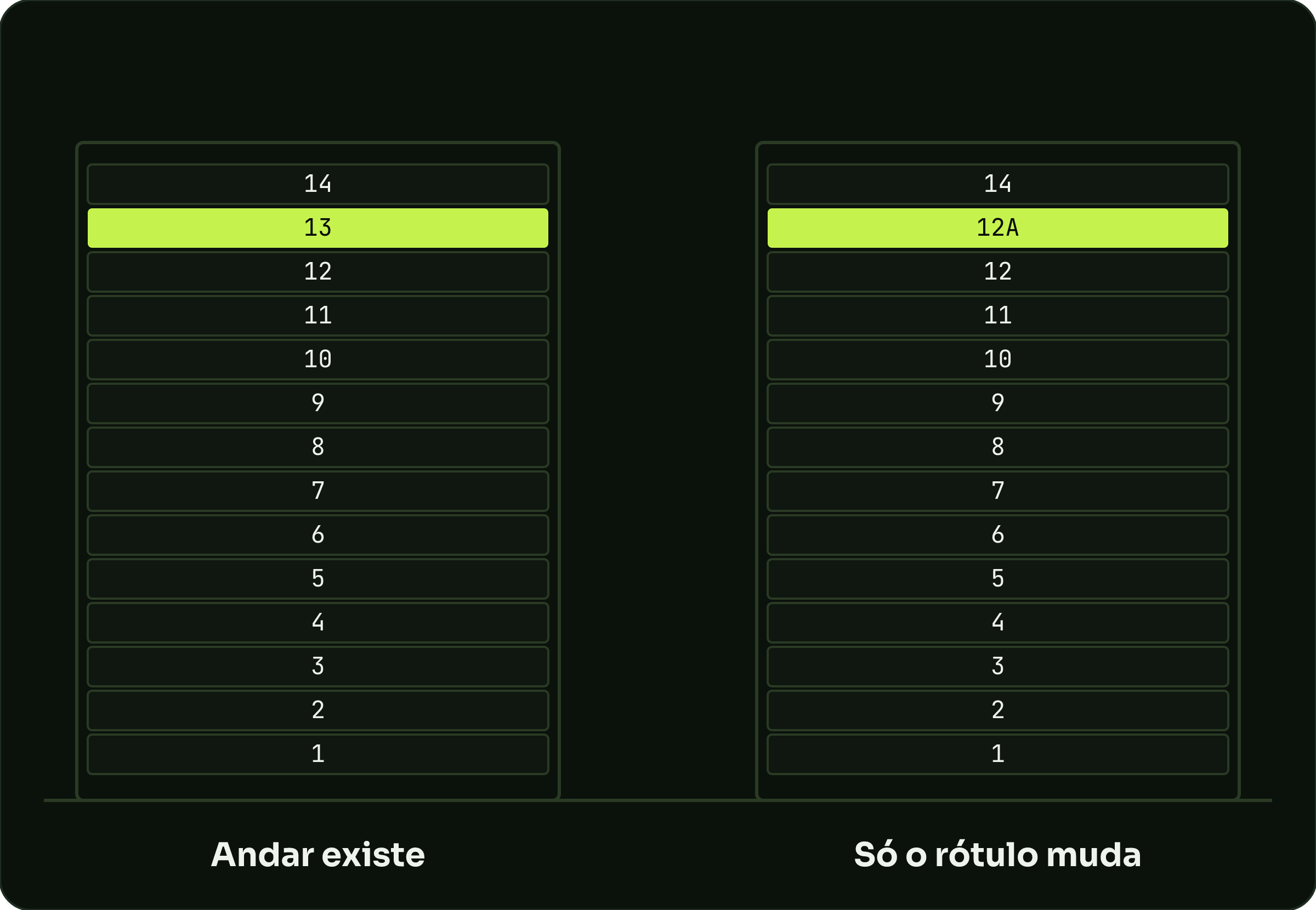
Who decides this? According to the same The Taken for Granted, in most places there’s no law requiring 13 to be skipped. It’s the builder’s choice. And the numbering doesn’t even have to be sequential: course material from the University of California, Berkeley about the New York City Department of Buildings shows that.
How many buildings skip 13?
Here the numbers change depending on the study, and each one deserves a careful look. According to Columbus International, Otis Elevator estimated, with 2002 data, that about 85% of elevators in the US skip 13.
The University of South Carolina, citing Otis, says that for every building with a 13th floor there are six that jump straight from 12 to 14 (source). Meanwhile, a 2020 StreetEasy study analyzed 629 residential buildings in New York and found 9% labeling a 13th floor, according to Columbus International. Since that sample covers only New York and only residential buildings, the number doesn’t hold for the whole country.
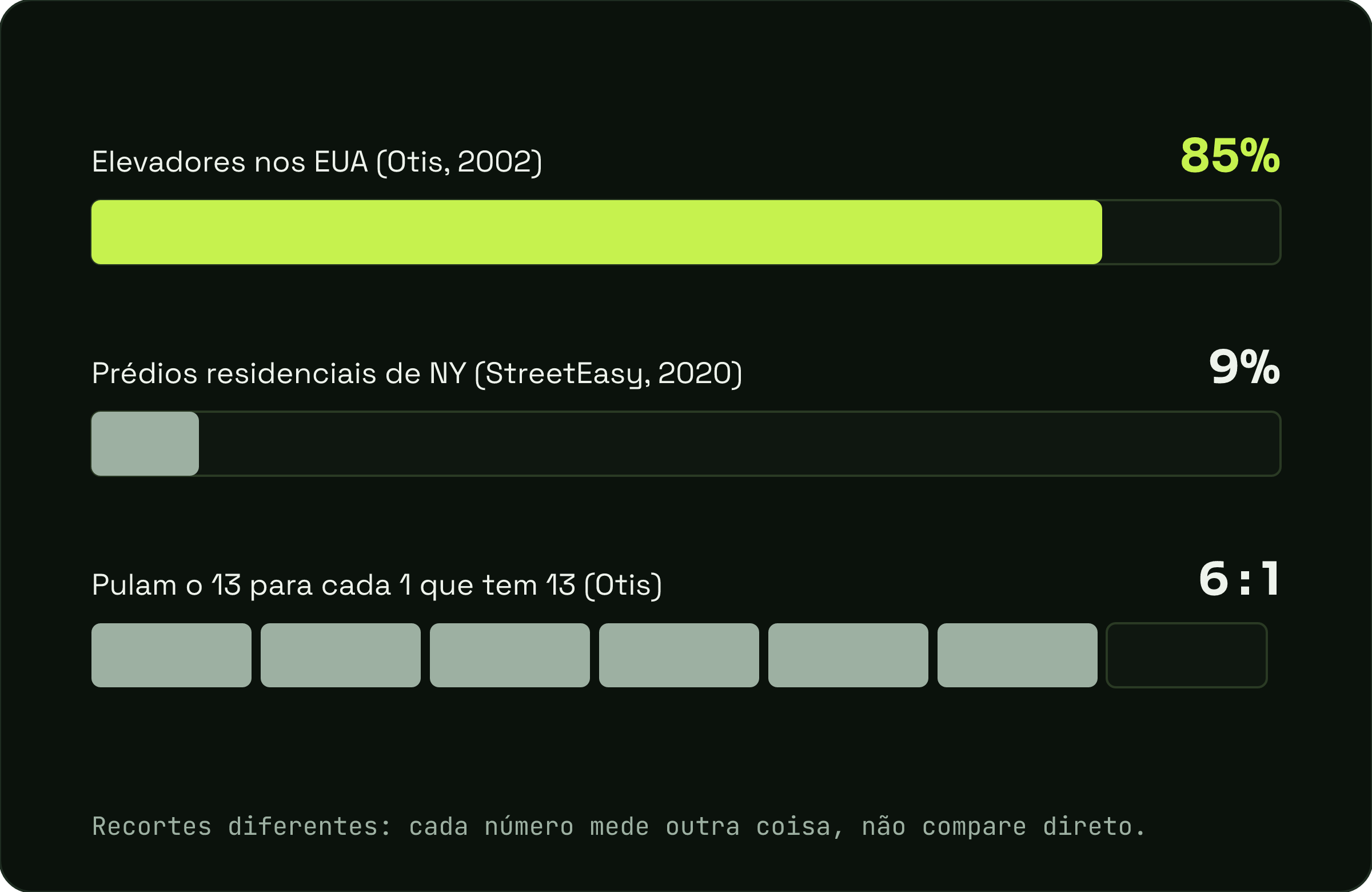
Nine percent and 85% don’t measure the same thing: one is an estimate of elevators across the whole country, the other is a sample of residential buildings in New York. Even airline seat rows skip 13, also according to the University of South Carolina.
Why this matters to you
What changed is that the superstition became material for movies and weekend conversation. What stays the same is the floor: it’s there, and the label is the builder’s decision.
Next time the elevator jumps from 12 to 14, you’ll know there’s nothing wrong with it, only with the counting someone chose to use. And when someone tells you Friday the 13th is an unlucky day, ask where the story came from. The honest answer, so far, is that it depends on who’s telling it.