Why isn't the keyboard in alphabetical order?
The first typewriter keyboard went from A to Z. Within a few years it became the QWERTY on your phone, thanks to jamming metal bars and telegraph operators.
Look at your keyboard right now. The first row of letters starts with Q, W, E, R, T, Y. No A, B, C. Your phone is the same. If you’ve ever wondered who decided to scramble the alphabet, the answer is: nobody did it all at once. The keyboard changed little by little, because of very practical problems with a 19th-century machine.
And yes, it started out in alphabetical order.
A keyboard that looked like a piano
The story begins in the United States in the 1860s. Christopher Latham Sholes was a printer, newspaper owner, politician and part-time inventor. With a few partners, he patented one of the first typewriters in 1868. According to Smithsonian magazine, its keyboard looked like a piano’s, with about two dozen keys in alphabetical order.
Makes sense, right? If you’re inventing a keyboard from scratch, putting the letters in the order everyone already knows seems like the obvious choice.
The problem was inside the machine.
The bars that jammed
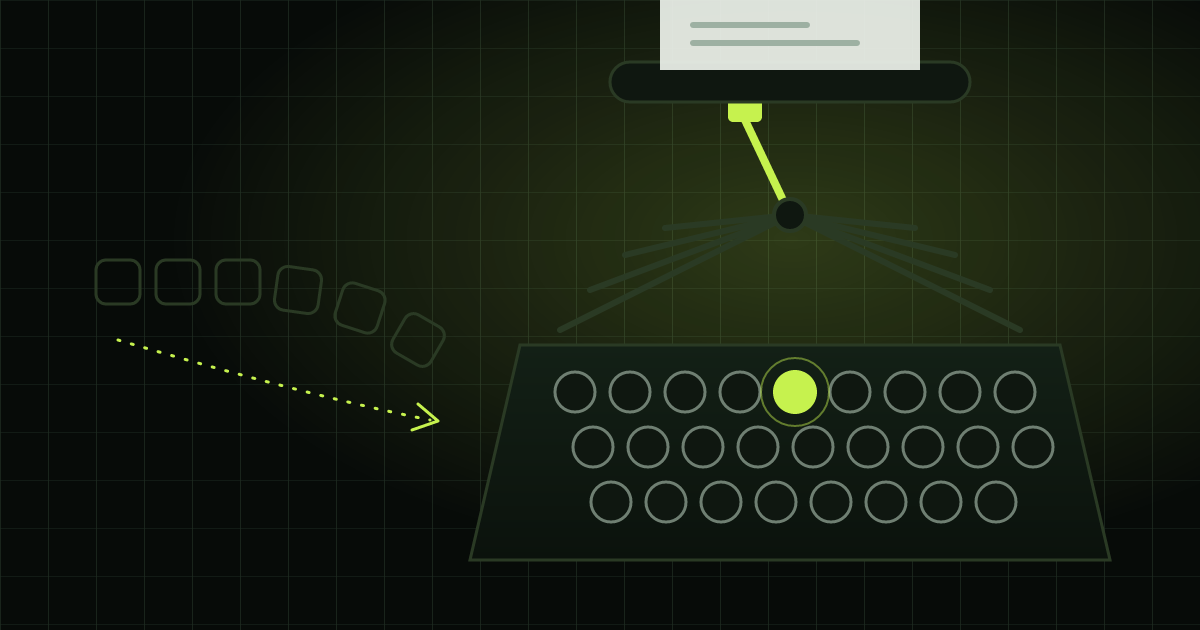
In those machines, each key moved a metal bar with a letter at its tip. The bar swung up and struck the paper, like a tiny hammer. The bars were arranged in a semicircle, and letters next to each other in that semicircle had bars next to each other.
When someone quickly pressed two keys whose bars sat side by side, they could tangle and jam the machine. The most famous explanation says Sholes kept moving letters around to separate pairs that show up together a lot in English, like “th” and “he”, to avoid jams.
But that explanation doesn’t hold up on its own. Smithsonian itself points out that E and R sit right next to each other, even though “er” is one of the most common pairs in English. Something else was pulling the letters around.
Enter the gun factory
In 1873, Sholes’s group signed a deal with E. Remington and Sons, a firearms manufacturer. Remington’s mechanics made a few more tweaks, like swapping the R with the period, and ended up with something practically identical to today’s QWERTY.
The machine hit stores in 1874 for about 125 dollars, a hefty price at the time, according to Smithsonian. It could only type capital letters. The Shift key, which let one machine type both upper and lower case, appeared in the next model, the Remington No. 2, in 1878.
The telegraph operators’ clue
In 2011, researchers Koichi and Motoko Yasuoka, from Kyoto University in Japan, published a study called On the Prehistory of QWERTY with a different explanation. In their view, the people who most influenced the order of the letters were telegraph operators.
A telegraph operator received messages in Morse code (the dots and dashes) and wrote them down on paper. They spent all day transcribing messages and needed speed, which made them some of the first people interested in typewriters. One example from the research, cited by Smithsonian: in American Morse, Z was easily confused with the pair “SE”. So it made sense to keep S close to both Z and E. Check your keyboard: that’s exactly how it is.
Historians still debate which explanation carries more weight. Most likely both played a part.
The myth of the keyboard built to slow you down
You may have heard that QWERTY was designed on purpose to slow down people who typed too fast. That story spread widely, but it doesn’t hold up.
The Yasuokas’ research points to the opposite: telegraph operators had to keep pace with whoever was sending the message, so nobody there wanted a slow keyboard. And separating letters that appear together makes you alternate hands more often, which may even help with speed. The goal was to keep the machine from jamming, not to make people go slower.
So why did nobody ever change it?
After 1874, QWERTY gained an advantage no other keyboard could catch up with: trained people. In 1893, Remington and other big manufacturers joined forces in the Union Typewriter Company, which adopted QWERTY as the standard, Smithsonian reports. Typing schools taught it, companies bought machines with it, and typists only knew how to use it.
There were attempts to change. The most famous is the Dvorak keyboard, created in the 1930s by August Dvorak, which puts the most common English letters on the middle row. Some tests at the time showed an advantage, but many of them were funded by Dvorak himself. In 1990, economists Stan Liebowitz and Stephen Margolis published The Fable of the Keys, questioning the idea that Dvorak was far superior. The result: it never caught on.
When computers arrived, the original reason was gone, because a computer has no bars to jam. But QWERTY stayed anyway. Economists call this path dependence: an old choice keeps winning because switching would cost too much for everyone at the same time.
Every country tweaks it a little
Each country made small adaptations. France uses AZERTY. Germany’s QWERTZ swaps Z and Y, because Z shows up a lot in German, according to Wikipedia.
In Brazil, where I live, the standard is ABNT2, defined by the ABNT NBR 10346 standard. It keeps QWERTY’s letter order and adds Portuguese accents, the letter Ç and an AltGr key for extra symbols, as Canaltech explains.
What this has to do with you
I started programming when I was 11, and I think I’ve typed more on this keyboard than with any other tool in my life. Even so, I had never thought of it as a direct inheritance from a machine built 150 years ago.
It’s a good lesson about technology: the best solution doesn’t always win; often the one that got there first and became a habit does. Next time you type a message on your phone, notice it: you’re using the keyboard of a machine that doesn’t even exist anymore, with the letters in an order that solved a problem with metal bars in 1874.
Oh, and try this: the word TYPEWRITER can be typed using only the letters on the top row.