19 minutes to download a song: the internet in the 90s
The modem singing, the phone line busy and waiting for midnight. What going online was like in the 90s, and why one song took almost 20 minutes.

If you’re over 35, you can probably hear it right now, from memory: a dial tone, some beeps, a shrill screech and, if everything went right, silence. It was the sound of someone going online.
This text goes with the new video on the channel (in Portuguese), where I travel back to the internet of the 90s. Here are the story, the math and the sources.
The internet reaches Brazilian homes
In Brazil, the network had existed since the late 1980s at universities and research centers. It only reached ordinary people in 1995, when dial-up access started being sold to anyone who wanted it. In May of that year, the Brazilian Internet Steering Committee, CGI.br, was created, and it still coordinates the network in the country today, according to RNP, the network that connected Brazilian universities and carried part of the commercial traffic until 1998.
And the way in was through the home phone.
The internet was a phone call
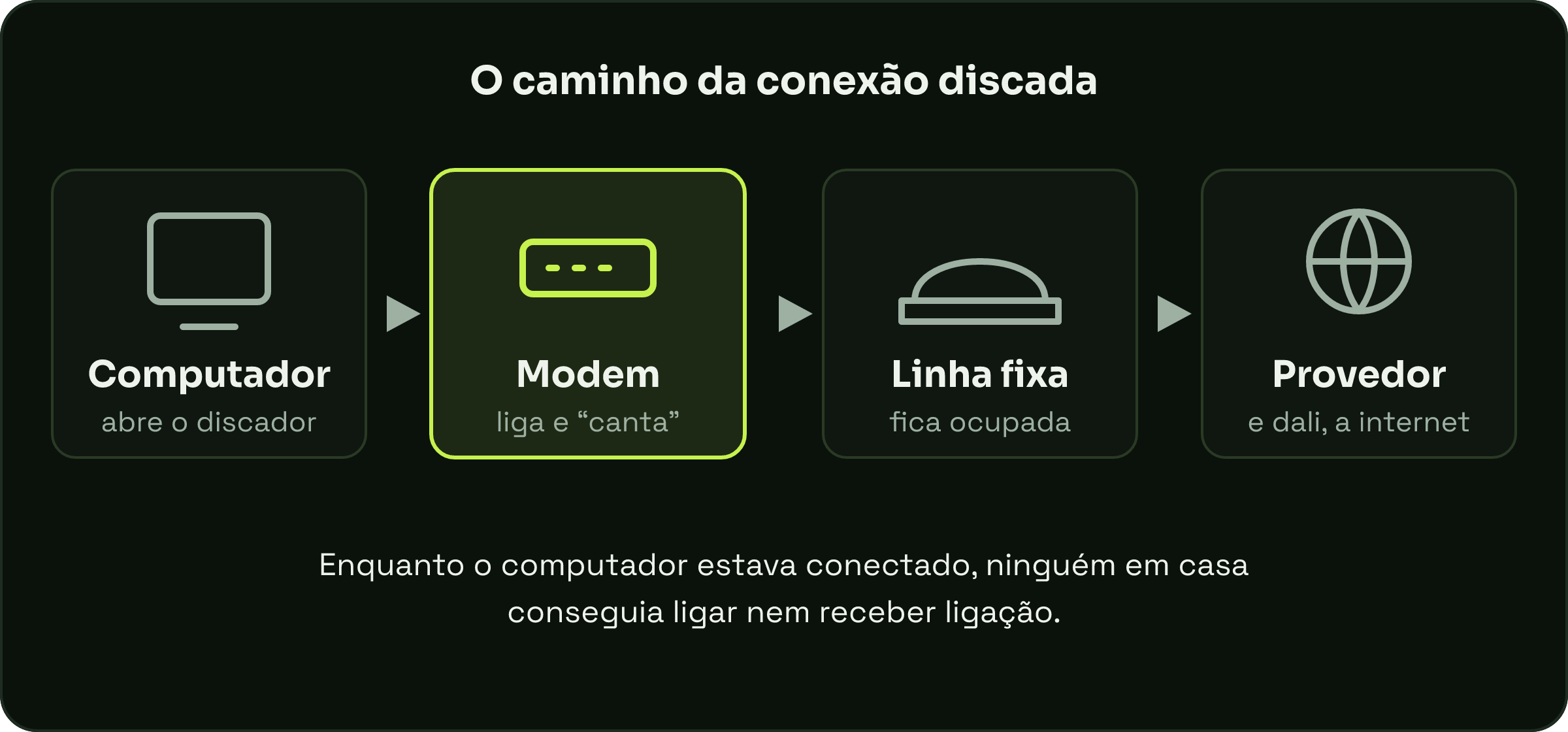
A dial-up connection worked like this: you opened a program called a dialer, which told the modem (the device that turns the computer’s data into sounds and the sounds back into data) to call the provider’s number, the company that gave you access. On the other end, another modem picked up. From then on, everything you saw on screen traveled as sound over the phone wire.
Everyone remembers the side effect: while the computer was connected, the line was busy, and nobody at home could make or receive calls, explains Hardware.com.br. And the connection could drop at any moment.
The noise had a reason
That screech wasn’t a defect. Phone lines were built to carry voices, so modems had to talk using sounds within the range the human ear can hear. At the start of the call, the two devices exchanged known tones to measure the line’s quality and agree on the highest speed it could handle, How-To Geek explains. It’s called the handshake between the machines.
And why could you hear it? The speaker was left on on purpose, so you’d know right away if the line was busy, if the number was wrong or if an answering machine picked up. Once the connection was established, the modem went quiet, and the data kept flowing in a hiss nobody needed to hear.
Waiting for midnight
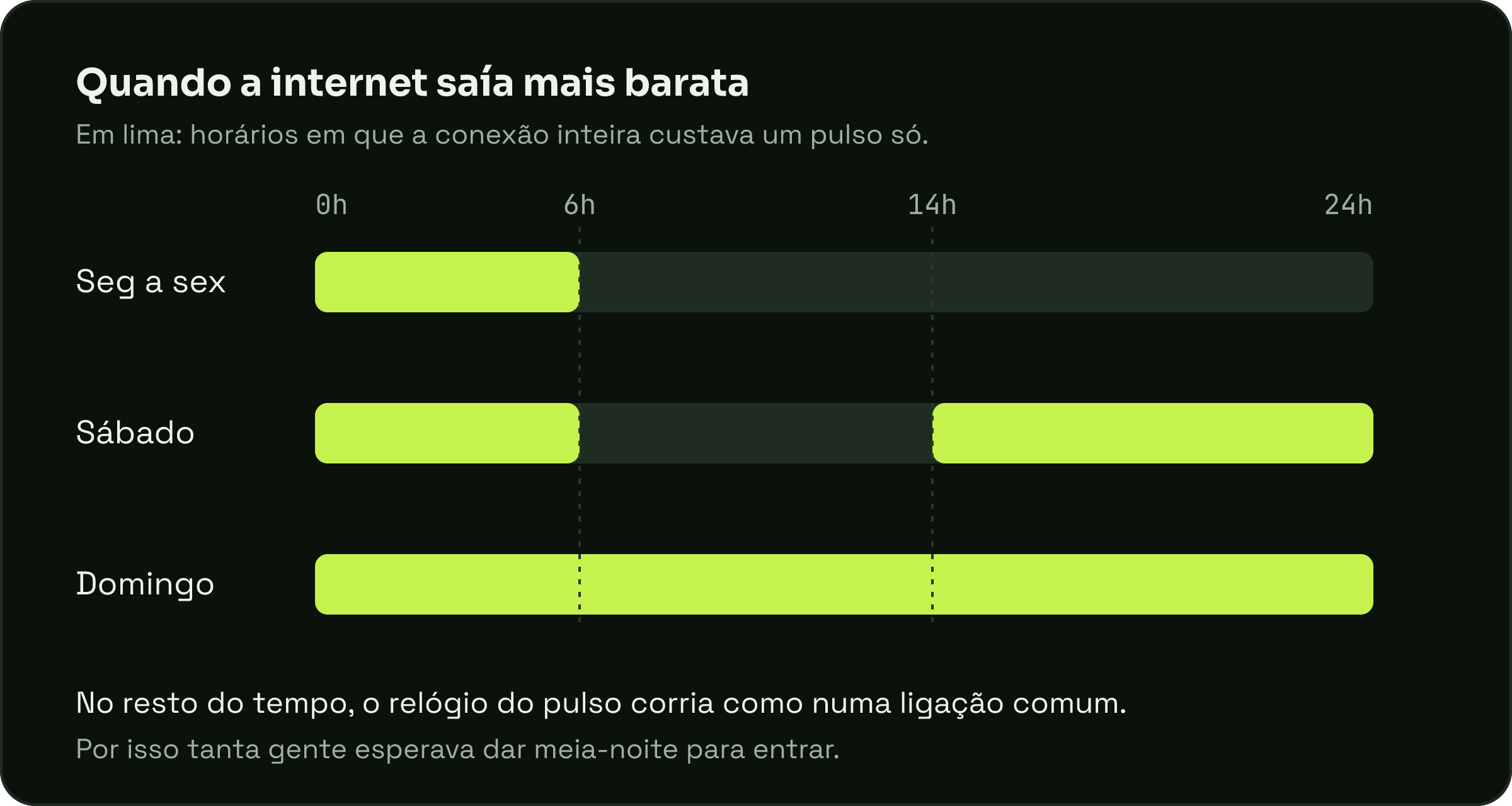
Since it was a phone call, the internet showed up on the phone bill. And in Brazil, billing was by pulse, a unit the phone company counted over the length of the call. During peak hours, the longer you stayed connected, the more pulses.
But there was a loophole. From midnight to 6 a.m. on weekdays, on Saturdays after 2 p.m. and all day on Sundays, the whole connection cost a single pulse, no matter how long it lasted, according to TecMundo and Hardware.com.br. The result: lots of people waited for midnight to go online.
The 19-minute math
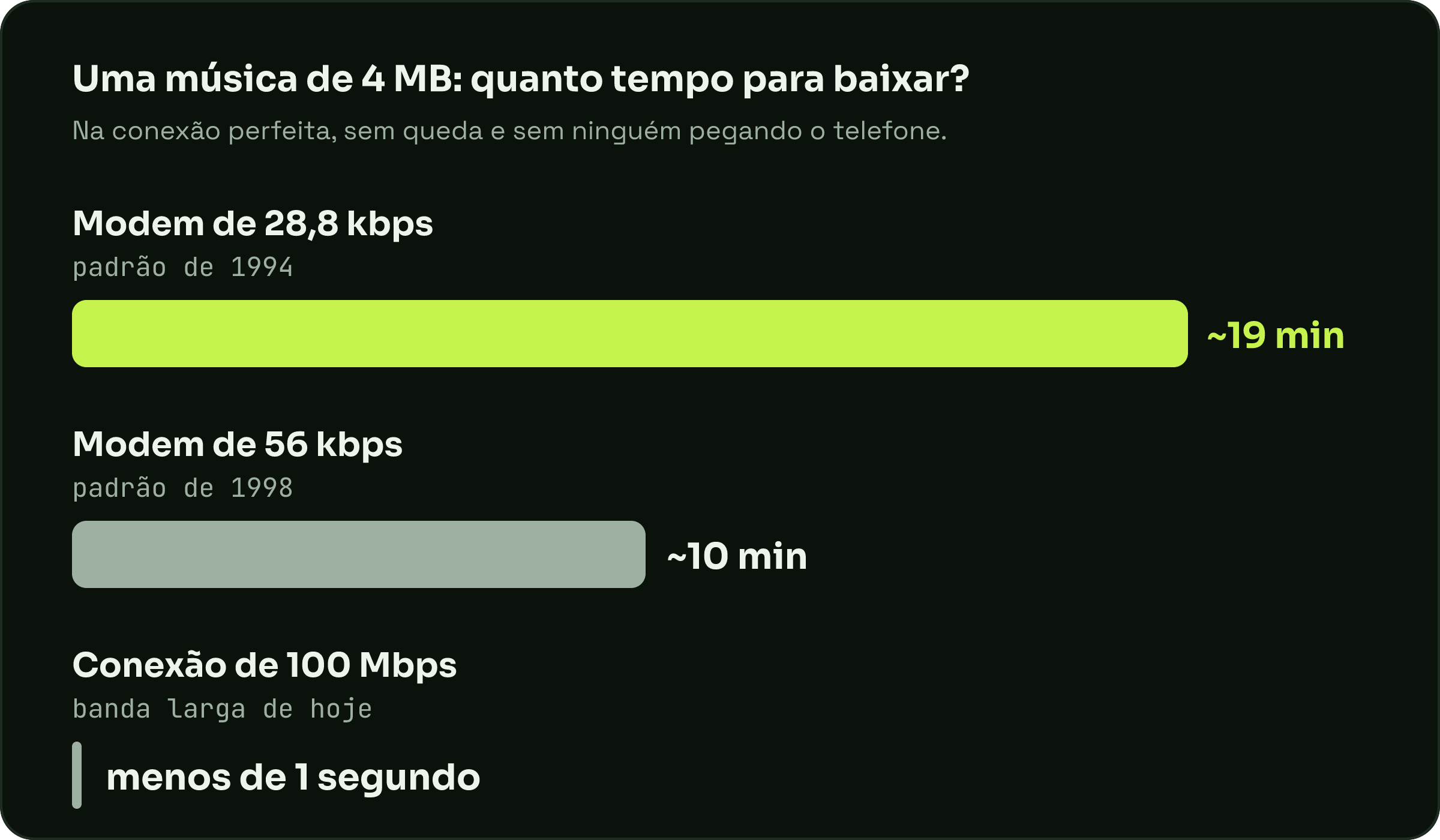
Now the part that gives the video its title. In 1994, the V.34 standard enabled 28.8 kbps modems, or 28,800 bits per second. In 1998 came V.90, at 56 kbps, the most an ordinary dial-up line can handle, according to Britannica.
A 4 MB song has about 32 million bits (each byte has 8 bits). Divide that by 28,800 bits per second and you get a little over 1,100 seconds: about 19 minutes, and that’s on a perfect connection, with no drops and nobody picking up the phone. On a 56k modem, about 10 minutes. On a 100 Mbps broadband connection, the same song arrives in less than half a second.
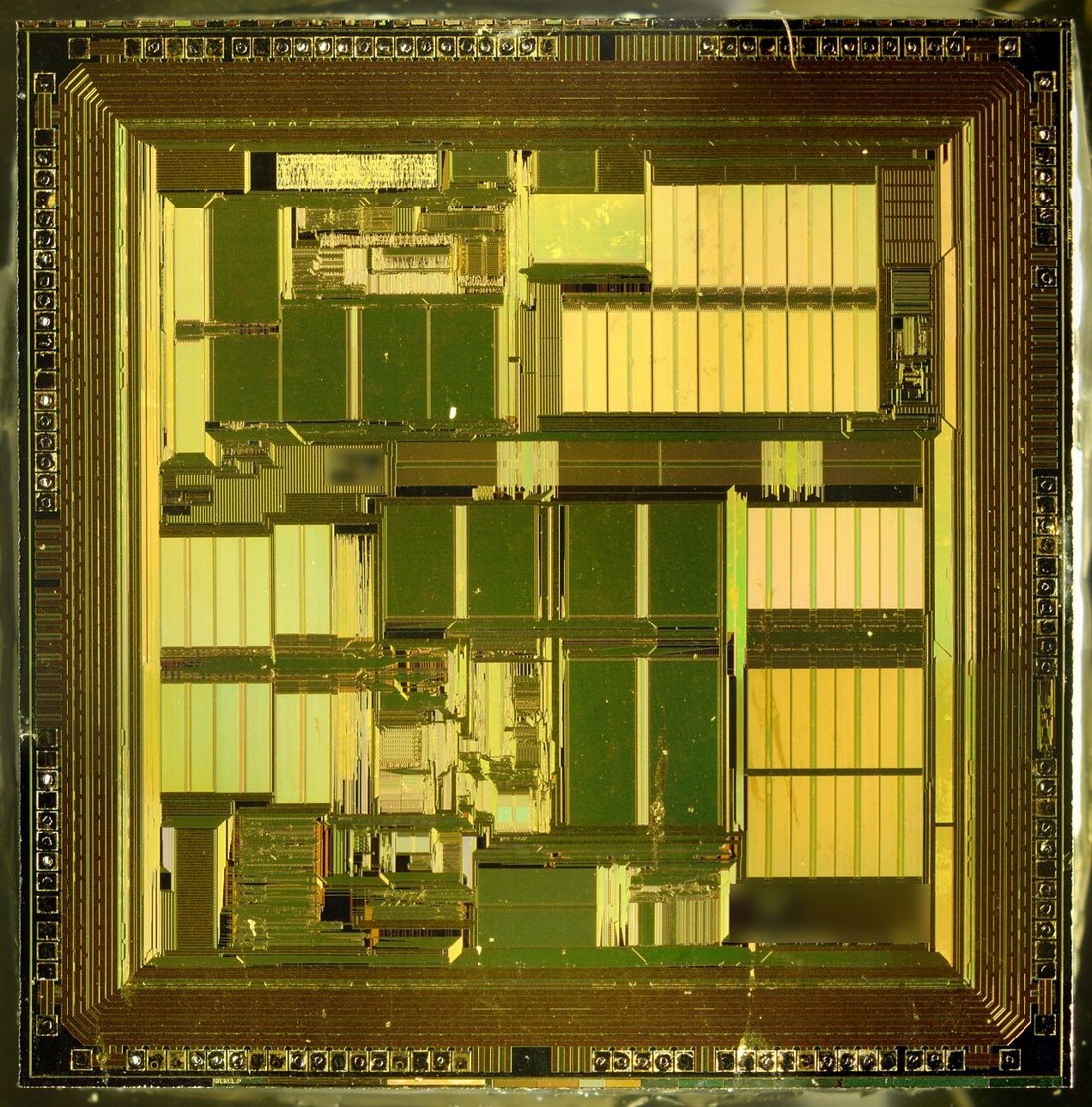
Inside, the modem relied on chips built for this conversation in sound. Magnified, one of them looks like a city seen from above.
What you could do in there
With so little speed, the internet of the 90s was made of text and small images. One of the most famous places was GeoCities, created in 1994, where anyone could build their own page for free, organized into “neighborhoods” by topic. Yahoo bought the service in 1999 and shut it down in the United States in October 2009. Before that, volunteers rushed to save as many pages as possible, recounts the Archive Team, the group behind that rescue.
To chat, many people used ICQ, launched in 1996 by the Israeli company Mirabilis. Each person had a number, and that number was what you gave your friends. The service held on for almost three decades and went offline on June 26, 2024, according to Forbes Brasil.
What changed and what stays the same
I started programming when I was 11, and the best lesson dial-up left me was patience: you thought twice before clicking a link, because every page cost time and, sometimes, a pulse.
What changed is almost everything: the speed, the price, the fact that the internet lives in your pocket and not tied to the living room phone. What stays the same is the underlying idea: data traveling over wires (and now through the air too) from one machine to another. If you want to hear the modem again and see the other memories from that era, the video is on the channel.