How does a message cross the ocean? Through a cable on the seabed
It's not satellites. Almost all data between countries runs through cables as thick as a garden hose. The story starts in 1858, with 98 words that took 16 hours.
You send a voice message to a friend in Lisbon and they hear it almost instantly. Where did that audio travel? Many people bet on satellites, because that’s the image that stuck: the message goes up, curves through space and comes down on the other side.
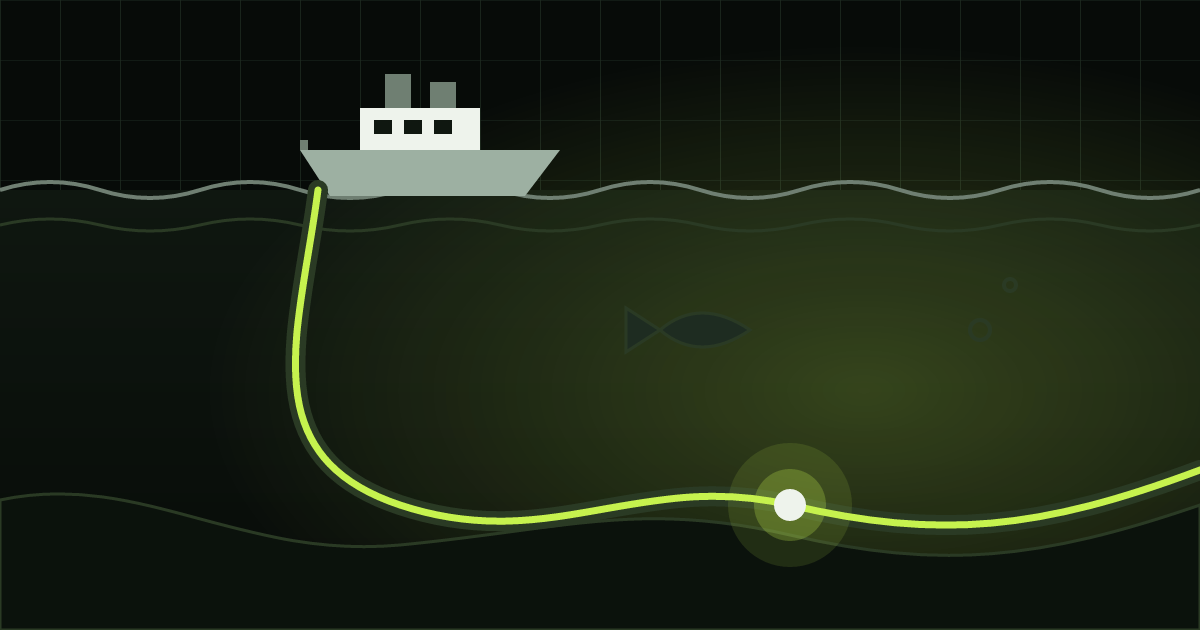
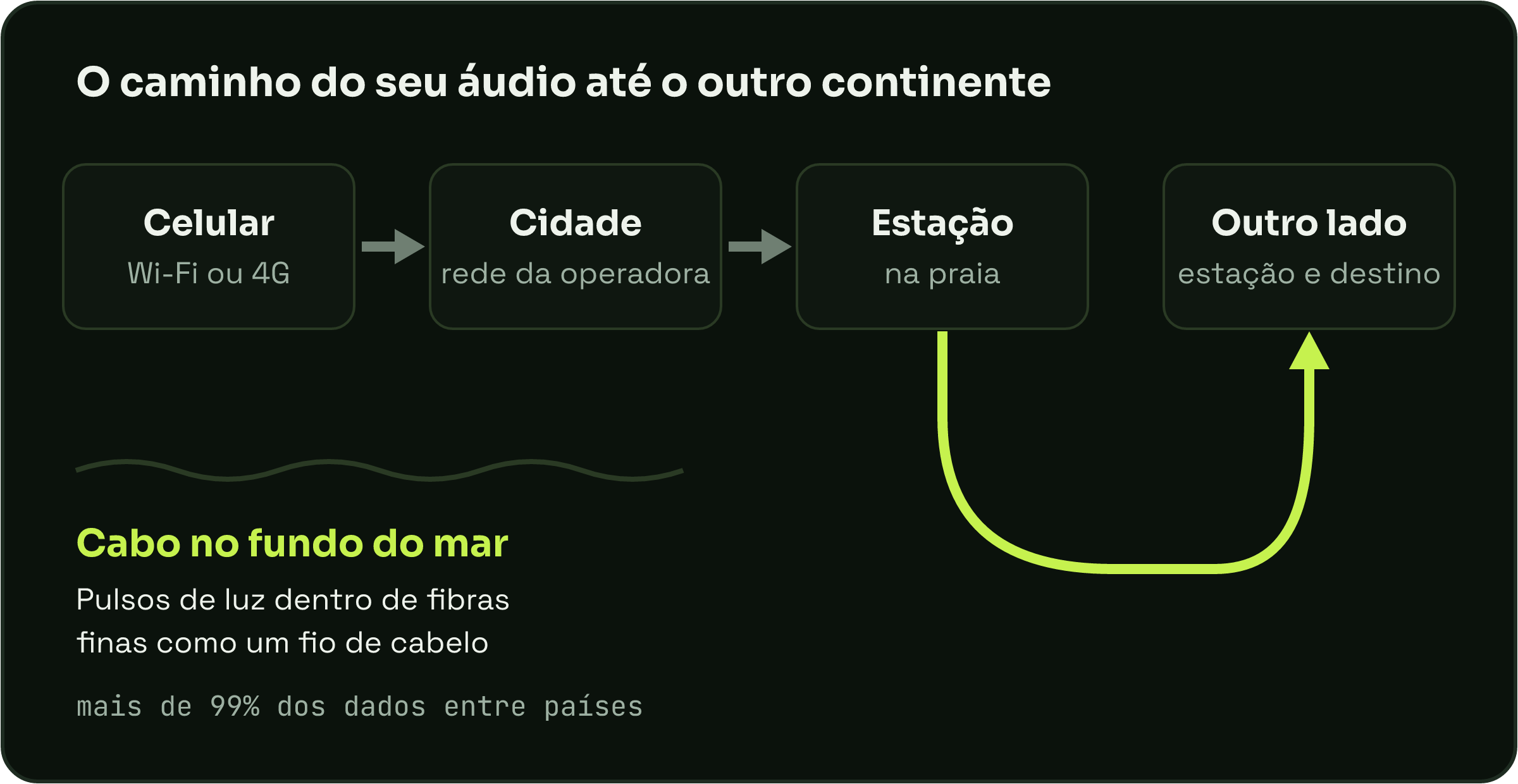
That’s almost never how it works. Your voice crosses the ocean lying on the floor, inside a cable.
The answer is at the bottom of the sea
According to the secretary-general of the International Telecommunication Union, the UN agency for the sector, submarine cables carry more than 99% of international data exchange. Satellites are useful for isolated places, but they handle a tiny slice: in the United States, only 0.37% of international capacity, according to TeleGeography, a company that maps these cables.
The same company estimates there are more than 1.5 million kilometers of cable in service, enough to wrap around the Earth more than 35 times. It sounds like science fiction, but the idea is almost 170 years old.
1858: 98 words in 16 and a half hours
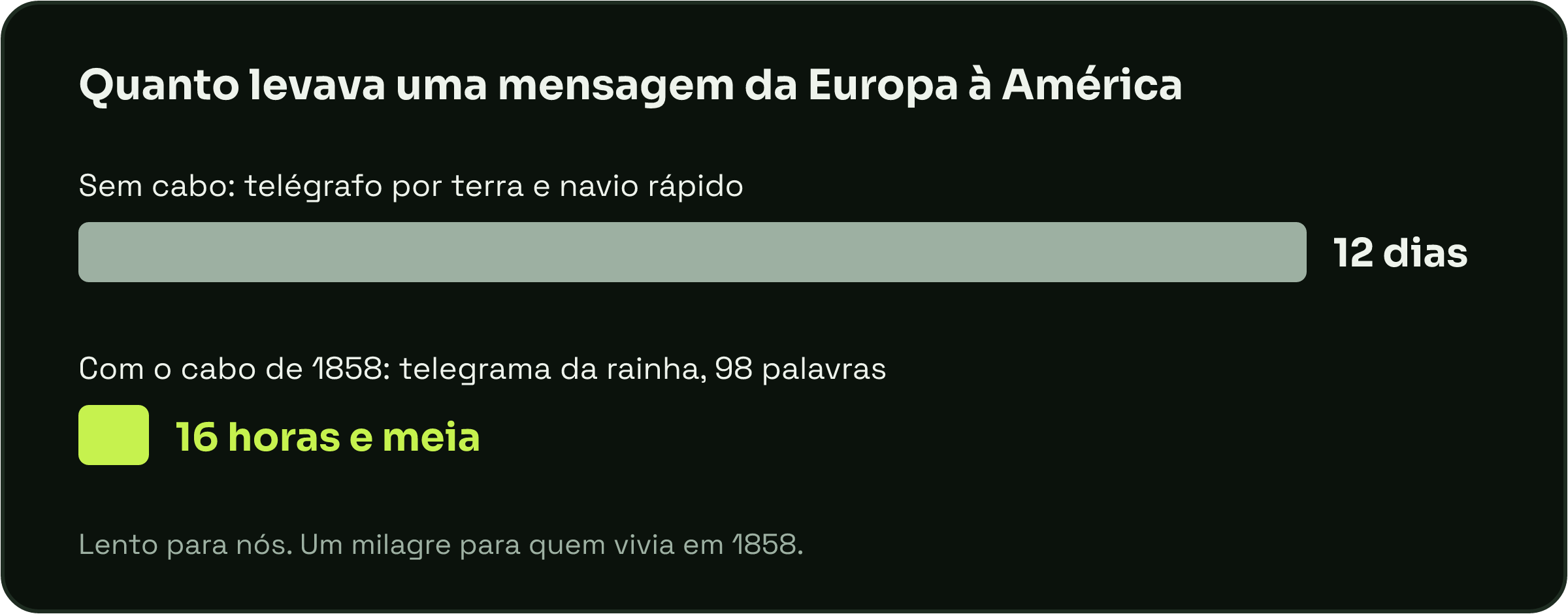
By the mid-19th century, the telegraph already ran over land, but it stopped at the beach. News between Europe and America depended on ships. Even combining the telegraph with fast steamships, it took about 12 days.
American businessman Cyrus Field decided to connect the two sides with a wire. In 1858, after failed attempts, two warships, the British Agamemnon and the American Niagara, met in the middle of the Atlantic, spliced the cable and headed in opposite directions, paying out wire along the way to Ireland and Newfoundland, now part of Canada.
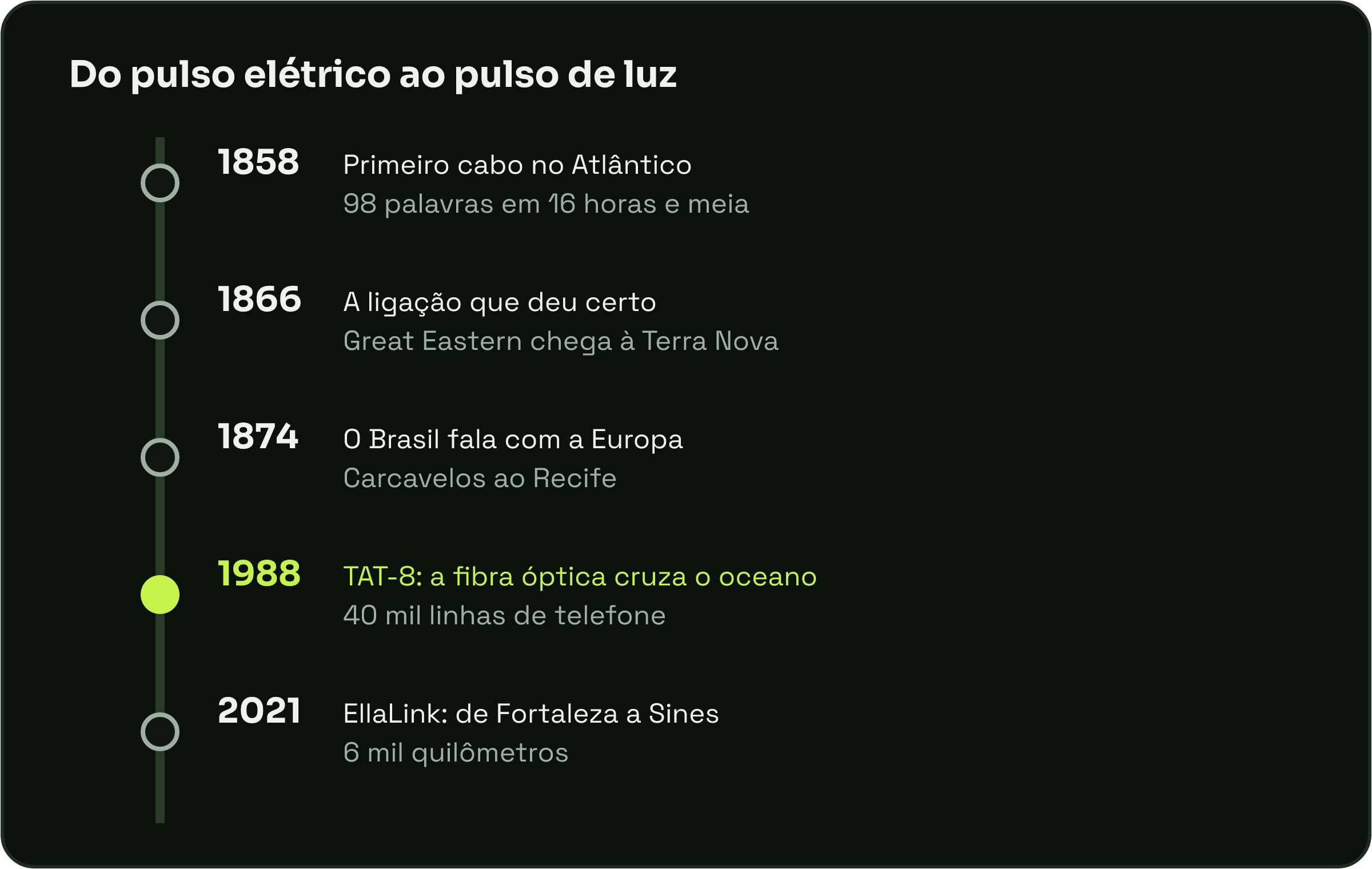
The first messages went through on August 17. The signal was so weak that Queen Victoria’s 98-word telegram to President James Buchanan took 16 and a half hours. Still, it was a feat: 16 hours instead of 12 days.
The celebration didn’t last. The cable had manufacturing defects in the copper and the insulation, and the venture’s chief electrician, Wildman Whitehouse, made things worse by raising the voltage when the signal started to fade. On September 18, after 271 messages, the cable died.
The ship that could hold the whole cable
The second chance came with a giant. The Great Eastern, a huge ship for its time, was converted into a cable ship because no other ship in the world could carry all that weight on its own: about 7,000 tons.
In 1865, the cable snapped midway and sank. A year later, the ship came back with another one. On July 27, 1866, the new line reached Heart’s Content, in Newfoundland. And the crew even fished the cable lost the year before off the seabed and finished it. Suddenly, there were two working cables.
The piece that turned the weak signal into a readable message came from British physicist William Thomson, the future Lord Kelvin. He created the mirror galvanometer, a meter so sensitive it picked up tiny electrical currents.
The day Brazil joined the line
Thomson also set foot in Brazil, where I live. In August 1873, he landed in Belém to oversee the cable that would connect the states of Pernambuco and Pará, inaugurated on September 5 that year.
The next year came the big leap. A cable connected Carcavelos beach, near Lisbon, to Recife, with stops in Madeira and Cape Verde. On June 23, 1874, the Jornal do Recife celebrated: only two hours had passed between the message and the reply. But it wasn’t for everyone. According to Pesquisa Fapesp magazine, a 20-word telegram to England cost the equivalent of 94 dollars at the time.
From electricity to light
For more than a century, cables were made of copper. The turning point came on December 14, 1988, with TAT-8, the first fiber-optic cable to cross an ocean. Optical fiber is a strand of glass that carries light instead of electrical current. TAT-8 could handle the equivalent of 40,000 phone lines, ten times more than the last copper cable.
It went out of service in 2002, and its removal began in 2025: a specialized ship pulled about a thousand kilometers of the cable off the seabed and took it to the port of Leixões, in Portugal.
Portugal, by the way, is still on Brazil’s map. In June 2021, EllaLink went live between Fortaleza and Sines, spanning 6,000 kilometers. Fortaleza became one of the hubs of this network, with 17 cables leaving the city, according to Pesquisa Fapesp. The route echoes the one from 1874, 147 years later.
A garden hose on the seabed
One of these cables is much thinner than you’d think. For most of the journey, it’s the width of a garden hose, and the fibers inside are as thin as a hair. Near the coast, it’s usually buried. In the open sea, it simply lies on the ocean floor.
Who foots the bill has changed too. Cables used to belong to consortiums of phone companies. Today, Google, Meta, Microsoft and Amazon are among the big investors.
Who cuts the cable? Not sharks
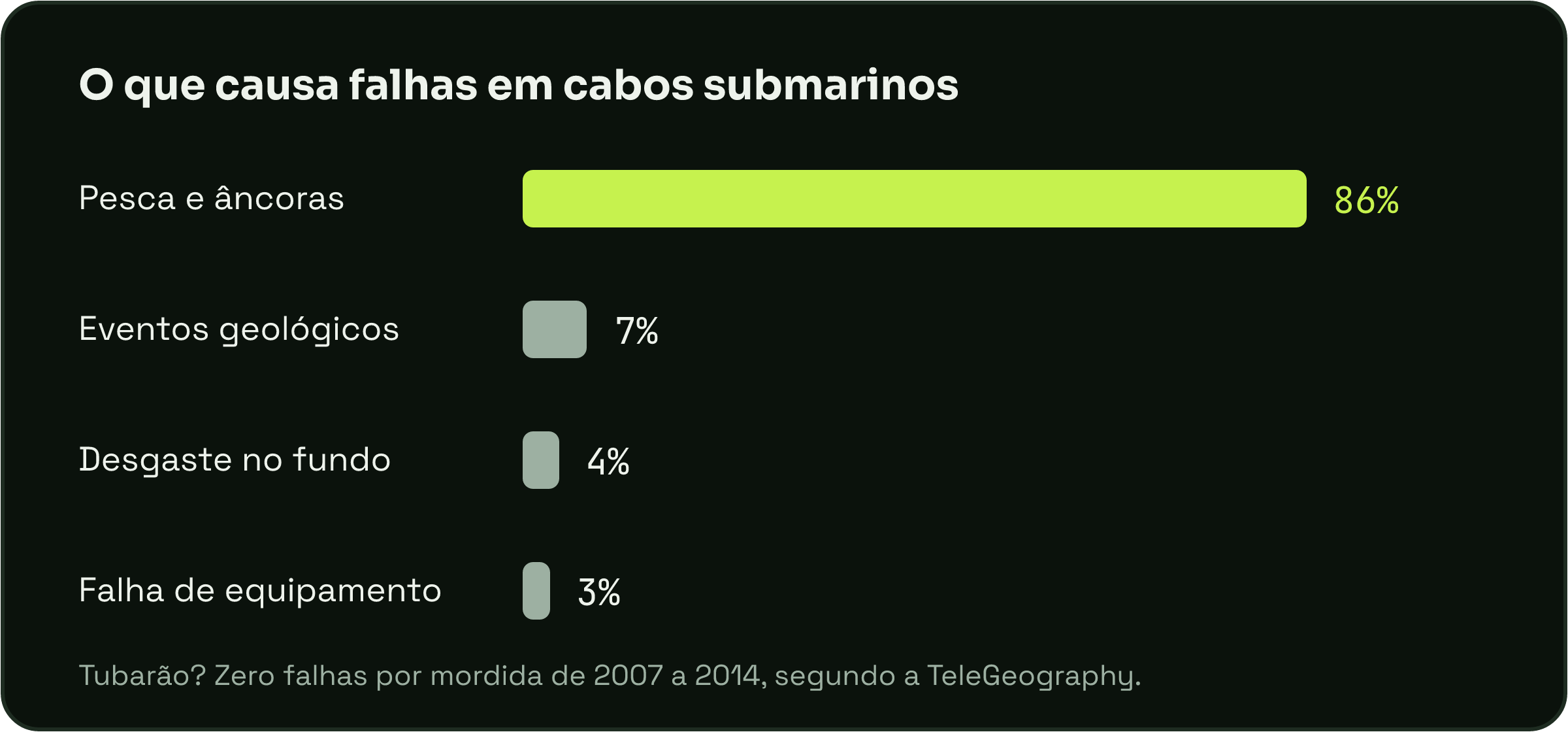
Sharks biting cables makes for a good story, and the concern was real: TAT-8 had an aluminum skin against bites. But the fish isn’t the villain: TeleGeography records zero faults caused by bites between 2007 and 2014.
There are about 200 faults a year worldwide, and most come from fishing and anchors. Estimates vary: TeleGeography says two thirds, and more recent data goes as high as 86%. Each repair costs between 500,000 and 1 million dollars.
What changed and what stays the same
In 1858, 98 words took 16 and a half hours. Today, a video reaches the other side of the world before you put your phone down. The cable changed, the signal changed, the price changed.
What stays the same is Cyrus Field’s idea: to talk to the other side of the sea, someone has to run a wire across it. So next time you hear that something is “in the cloud”, remember that the cloud has an address, and part of it lies at the bottom of the ocean.