LO: the internet's first message crashed midway
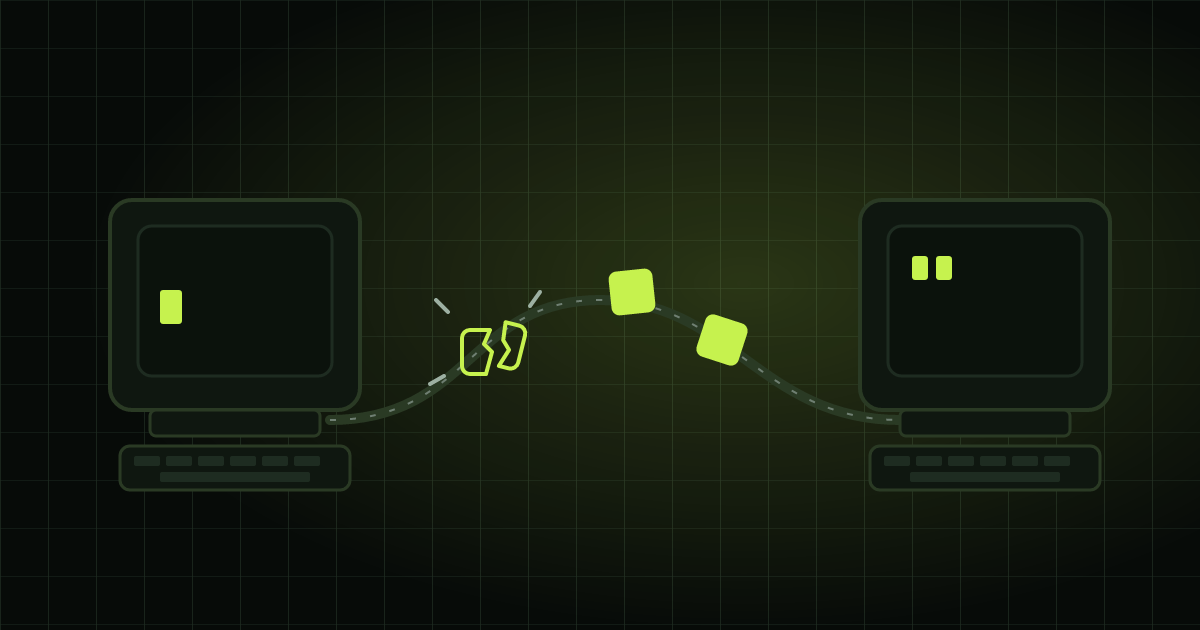
On October 29, 1969, a student tried to type LOGIN from one computer to another. Only the L and the O arrived. That's how the internet said its first hello.
You know when you type your password, hit Enter and the app freezes halfway? Well, the internet started exactly like that.
On October 29, 1969, at 10:30 p.m., in a lab at the University of California, Los Angeles (UCLA), a student tried to send the word LOGIN to a computer hundreds of kilometers away. The L and the O arrived. Then everything stopped. That was 57 years ago today, and this is the story of how the network you’re using to read this said its first “hello”, with a bit of a stutter.
Why connecting two computers was a crazy idea
In the 1960s, a computer was a huge, very expensive machine that filled a room and belonged to a university or research center. Each one spoke its own language. If a researcher needed a program that only existed in another city, the way to get it was to travel.
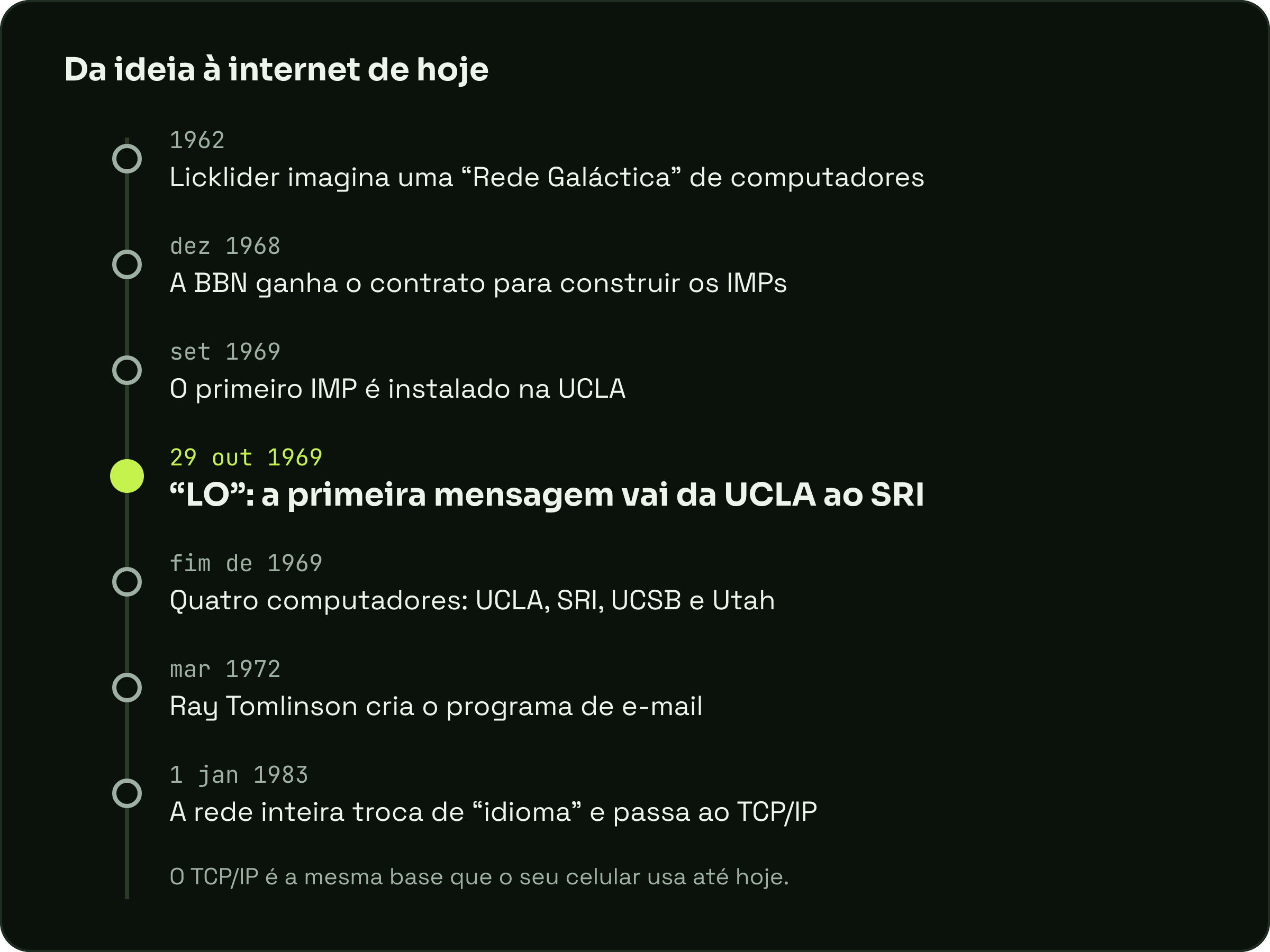
In August 1962, MIT researcher J.C.R. Licklider wrote a series of memos describing a “Galactic Network”: computers around the world connected, with anyone able to access data and programs from anywhere. In October of that year, he became the first head of computer research at ARPA, the US Department of Defense’s research agency, according to the Internet Society’s history, written by the network’s pioneers themselves.
Cutting the message into little pieces
What was missing was the “how”. The telephone worked with circuits: when you made a call, a line was reserved for that conversation alone, from start to finish. For computers, which talk in bursts (a lot of data, then silence, then more data), that was a waste.
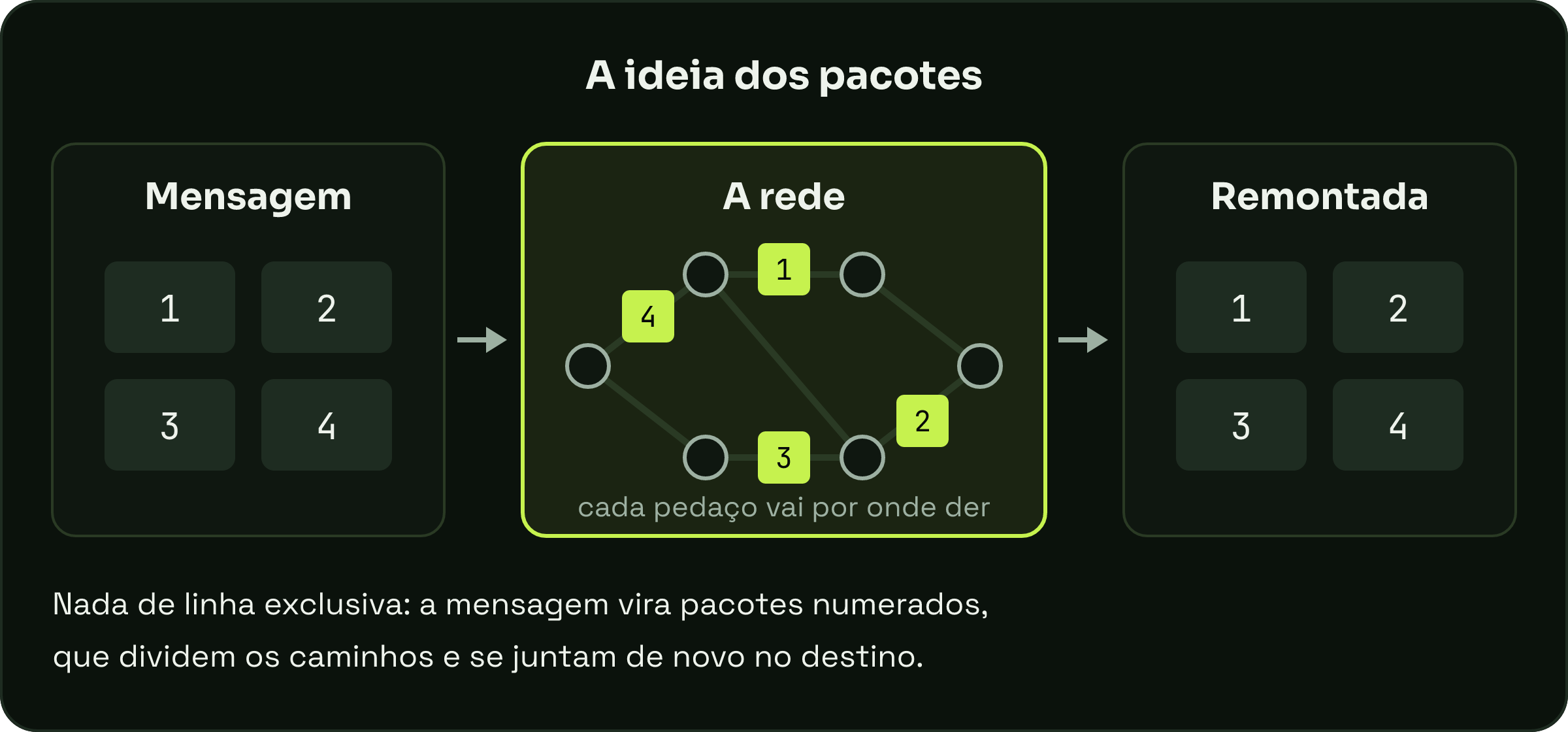
The answer was packet switching, a complicated name for a simple idea: cut the message into numbered pieces, the packets, send each one along whatever path is free and reassemble everything at the destination. Leonard Kleinrock published the first paper on this theory in 1961, while he was at MIT. Paul Baran, at RAND in the US, and Donald Davies and Roger Scantlebury, at the National Physical Laboratory in England, came to similar ideas almost at the same time, without knowing about each other, according to the Internet Society. So when someone asks “who invented the packet”, the honest answer is: more than one person.
The “refrigerator” that did the talking
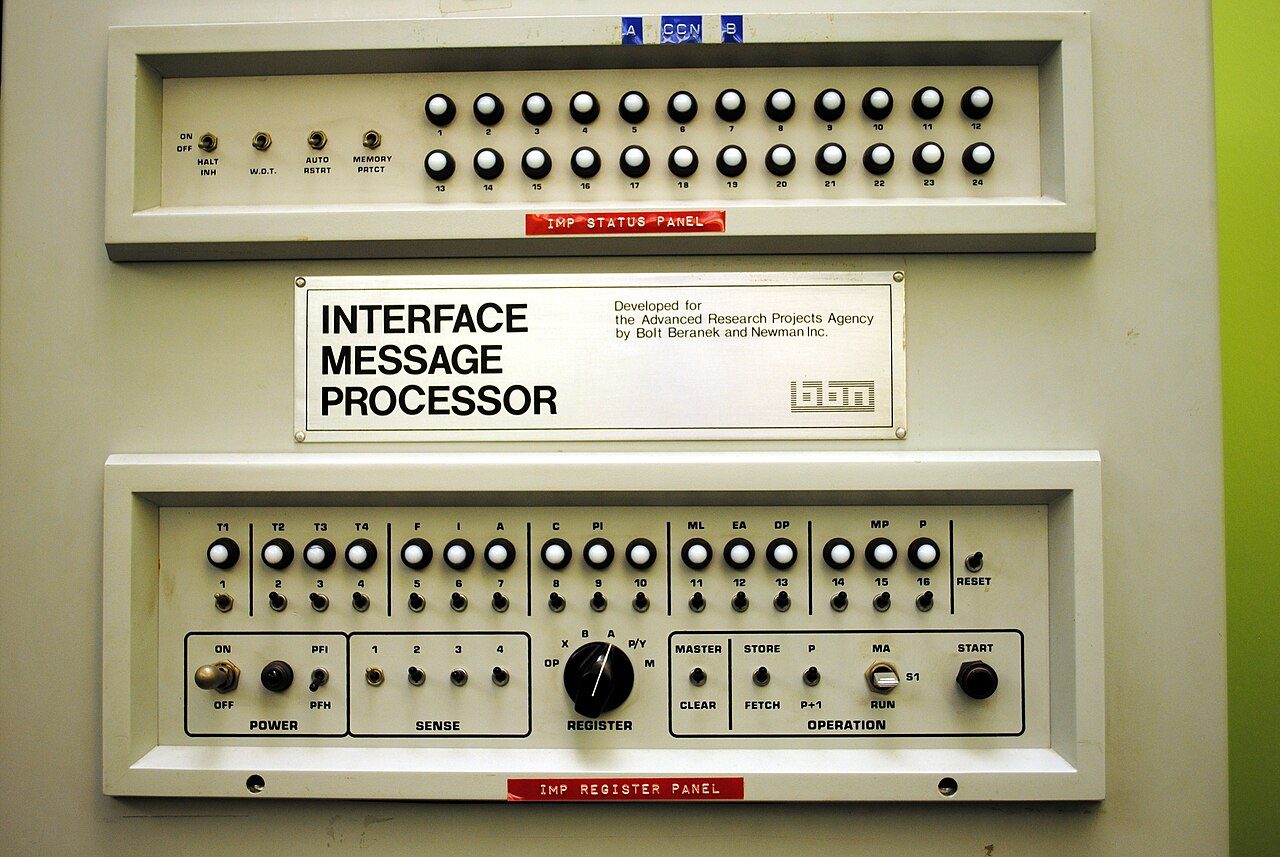
To avoid forcing every computer to learn to talk to all the others, ARPA decided to place an intermediary machine next to each one, the IMP (Interface Message Processor). Think of the IMP as a mail carrier: the computer hands it the message, and the IMPs take care of getting it to the other side.
The contract to build the IMPs was won in December 1968 by a team led by Frank Heart at BBN (Bolt Beranek and Newman), an American company. In September 1969, the first IMP was installed at UCLA, in Kleinrock’s lab, and about a month later the second arrived at the Stanford Research Institute (SRI), in Menlo Park, according to the Internet Society. UCLA describes the machine as the size of a refrigerator, and the lab, room 3420 of Boelter Hall, is now a small museum.
The night of “LO”
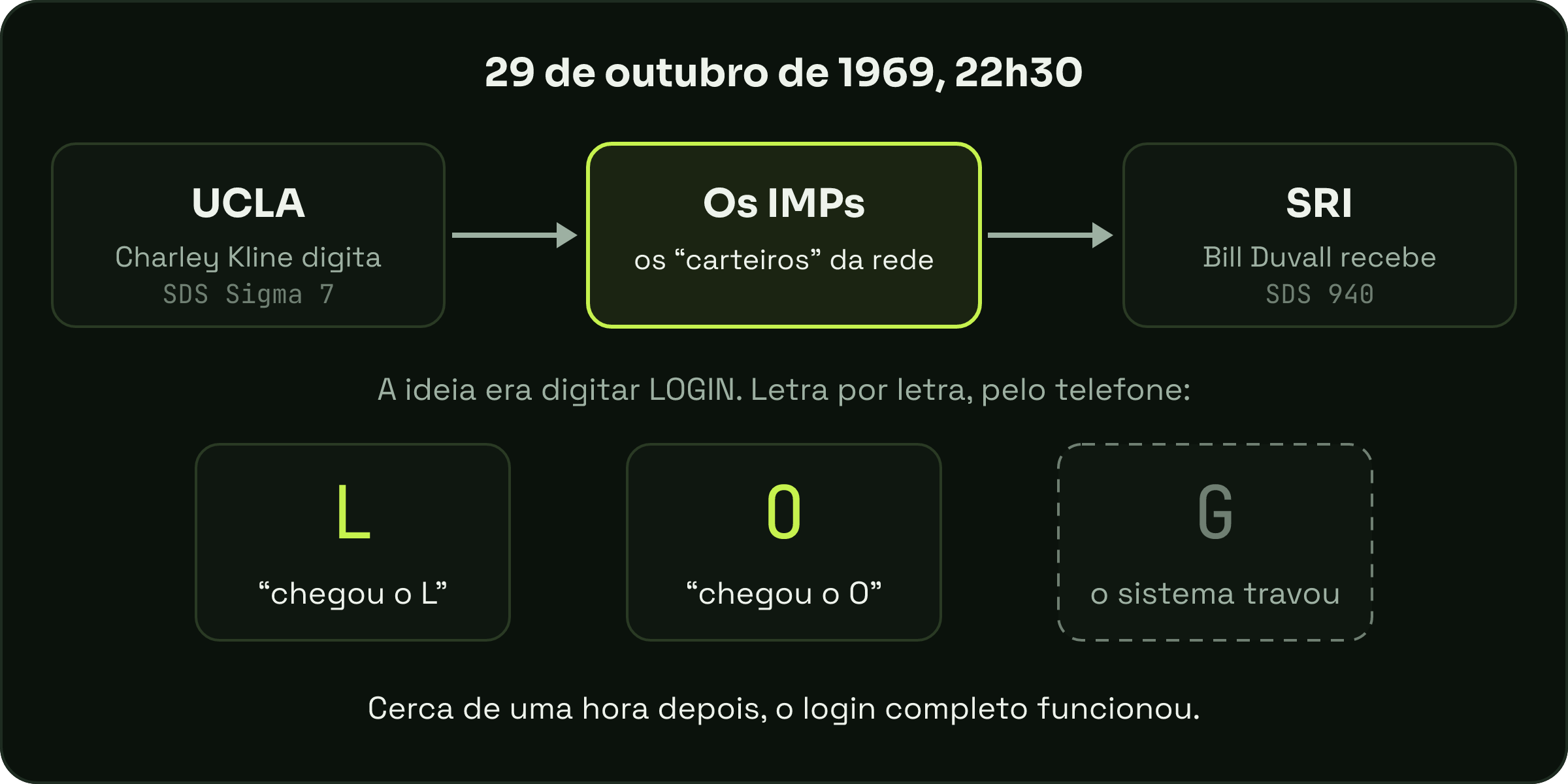
On the night of October 29, student and programmer Charley Kline sat in front of UCLA’s computer, an SDS Sigma 7, under Kleinrock’s supervision. On the other side, at SRI, programmer Bill Duvall was waiting at an SDS 940. The two talked over the phone, wearing headsets, to check that everything was arriving, the ICANN blog recounts (ICANN is the organization that coordinates internet addresses today).
The plan was to log into SRI’s computer. Kline typed the L. “Got the L,” Duvall answered. He typed the O. “Got the O.” He typed the G, and the system crashed. The first message in the network’s history was, by accident, “LO”, as Kleinrock’s page at UCLA records. About an hour later, with everything restarted, the full login worked.
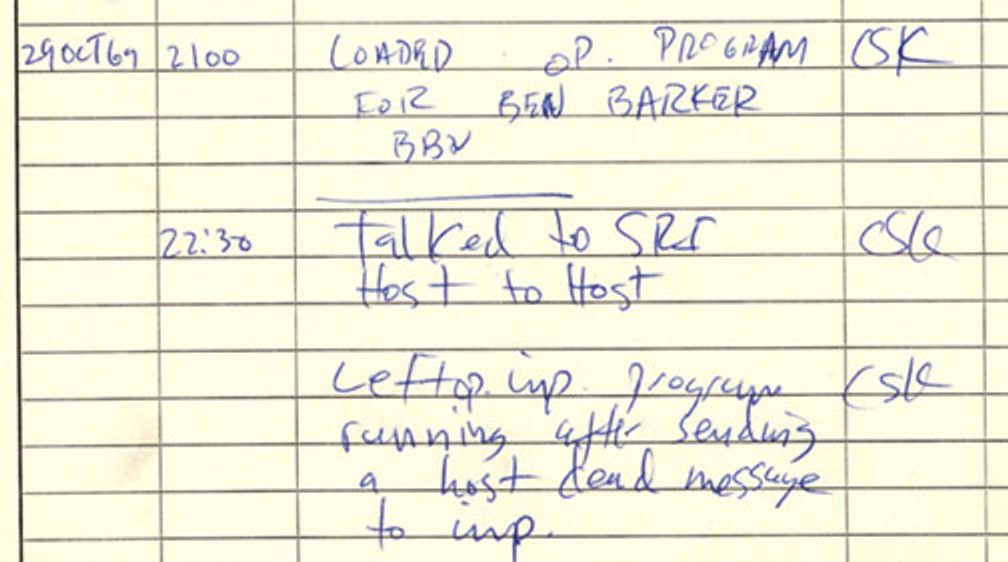
There is no photo or recording of that moment. What’s left is a handwritten line in the UCLA IMP logbook: “22:30 – Talked to SRI host to host”, with the initials CSK, for Charles S. Kline. It couldn’t have been more low-key for a moment like that.
The atomic bomb myth
You may have heard that the internet was created to survive a nuclear war. It’s one of the most repeated stories about it, and the pioneers themselves say it isn’t true. The Internet Society text, signed by people like Vint Cerf, Robert Kahn and Kleinrock himself, explains that the ARPANET never had that goal. The confusion came from a RAND study on secure voice communication in wartime, which did think about that, but was a different project. The ARPANET was born for something far less cinematic: letting researchers share expensive computers.
From four computers to your pocket
By the end of 1969, the network had four computers: UCLA, SRI, the University of California, Santa Barbara and the University of Utah. In March 1972, Ray Tomlinson, of BBN, wrote the network’s first email program. And on January 1, 1983, came a switchover: every computer on the ARPANET had to change, on the same day, the “language” it used to talk to TCP/IP, the rules that still organize the internet today, according to the Internet Society.
What changed and what stays the same
I started programming when I was 11, and one thing every programmer learns early is that the first attempt almost never works. It’s comforting to know the internet started that way too: with a crash, a “let me restart it” and a second try an hour later.
What changed is the scale. From that one line between two computers, the network became a tangle that covers the whole planet. What stays the same is the central idea: when you send a photo to the family group chat, it doesn’t travel in one piece. It’s cut into packets, each goes wherever it can, and everything is put back together on the other side, just like that night in 1969. Except now, almost always, without crashing at the G.