The 1988 worm: the miscalculation that choked the internet
38 years ago, a student released a program to gauge the network's flaws. One badly calculated rule froze thousands of computers, and digital security changed.
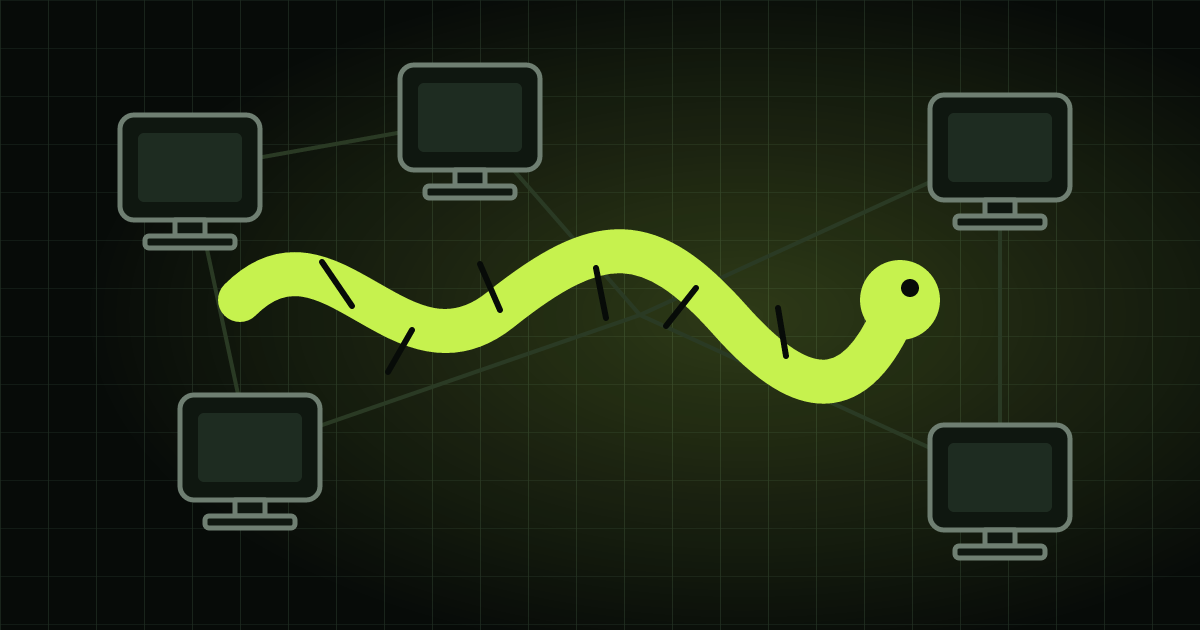
You know when your computer gets so slow that even the mouse pointer seems tired? Now imagine that happening at the same time at universities, research centers and military bases, on a Wednesday night, with nobody understanding why.
That’s what happened exactly 38 years ago, on November 2, 1988. The culprit was a student’s program, and the damage came from a miscalculation.
The student and the plan
Robert Tappan Morris was 23 and in the first year of a PhD in computer science at Cornell University. He was the son of a security expert from the NSA and Bell Labs.
In October 1988, he began writing a program to show how weak the network’s security was, according to the US court ruling on the case. The idea was for the program to spread far and wide without drawing attention, using very little of each machine.
That kind of program is called a worm: unlike a computer virus, it doesn’t need to hitch a ride on another program, because it travels on its own. The MIT team that dissected the case disagreed and preferred to call it a virus. The name that stuck was worm.
Four unlocked doors
Back then, the internet was a club of researchers, the military and universities, with about 60,000 computers. It was a network built more for collaborating than for defending itself. The US court listed four ways the worm got in.
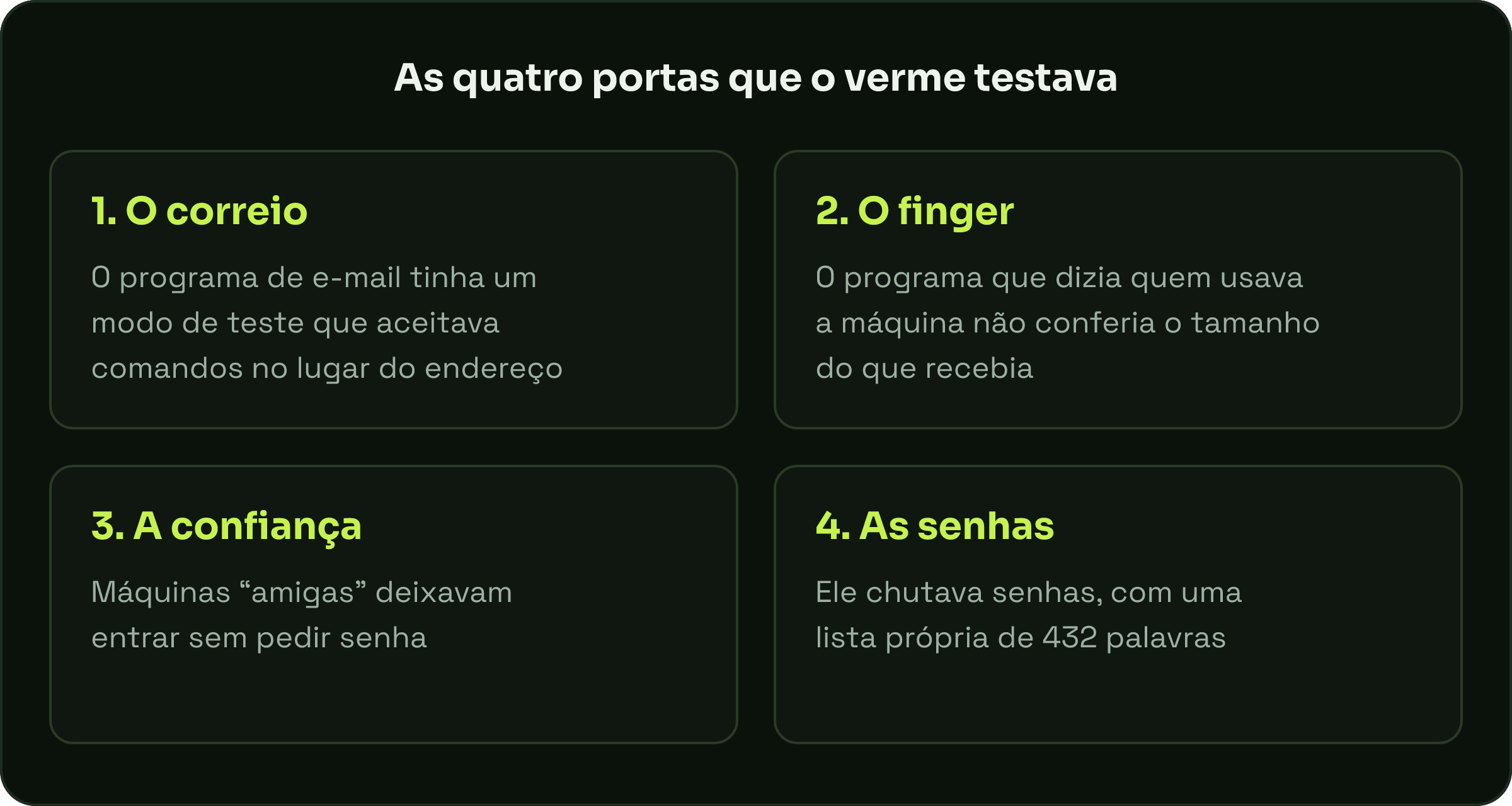
The first was sendmail, the program that delivered email. It had a debug mode, used for testing, that allowed commands to be run through the message itself. The second was finger, which told you who was using a machine and didn’t check the size of what it received. Send a text bigger than the space set aside and it overflows into places it shouldn’t.
The third was trust: “friendly” computers logged into each other without asking for a password. The fourth was good old guessing. The worm carried a list of 432 words to try as passwords, with gems like “password”, “wizard” and “banana”.
The miscalculation
Morris knew that a worm that installs itself many times on the same machine ends up getting noticed. So, before copying itself, the program asked the computer whether there was already a copy there. If the answer was “no”, it installed itself.
But a clever administrator could program the machine to always answer “yes” and stay protected. To prevent that, Morris created an exception: one in every seven “yes” answers, the worm copied itself anyway.
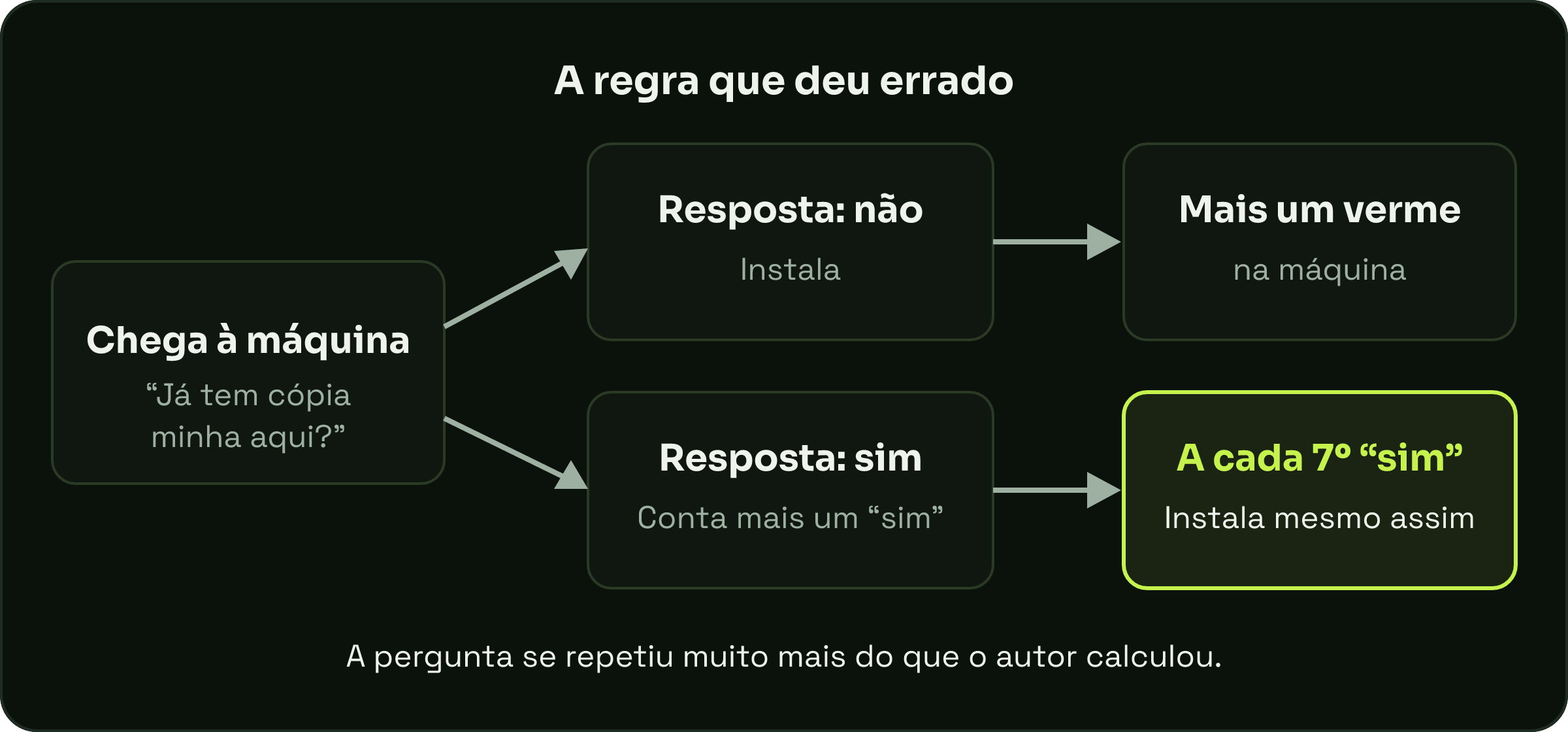
It sounds like little, but the court recorded that he underestimated how many times that question would be asked. Copies piled up, each fighting the others for the processor (the computer’s “brain”). Machines froze or stopped responding, including at universities, military installations and medical research centers.
It’s worth noting that the worm didn’t delete or damage data. The damage was leaving computers unable to work.
The night the network called for help
The FBI says the worm was released around 8:30 p.m., from an MIT computer. The court says he chose MIT to hide that the program came from Cornell. MIT’s analysis, however, points to a log entry at 5:01 p.m. at Cornell, which may have been a test, and notes that this origin is debated.
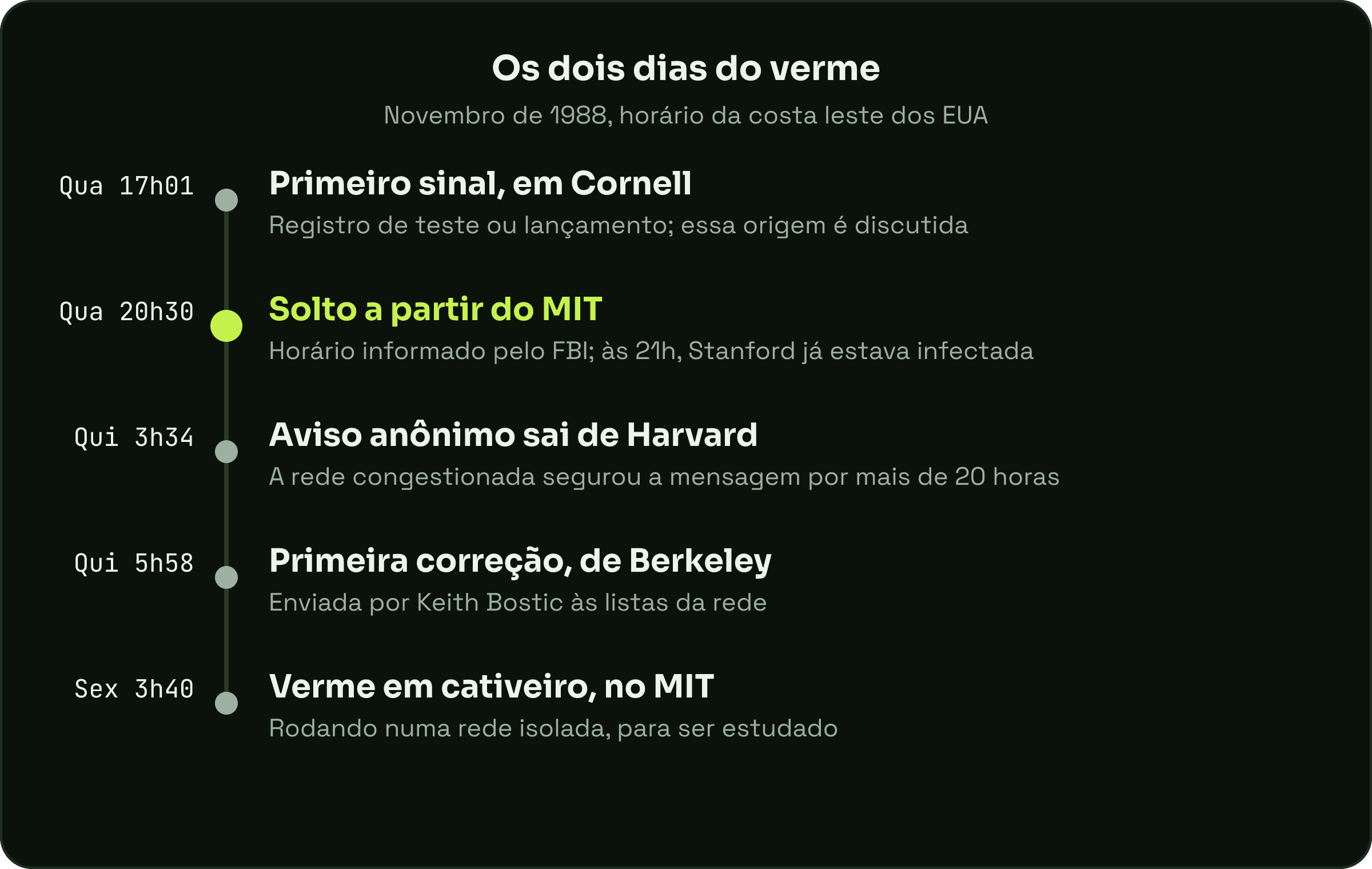
When he realized the size of the problem, Morris asked a friend at Harvard to send an anonymous message explaining how to remove the worm. The irony is cruel: the message went out at 3:34 a.m. on Thursday and sat stuck for 20 hours before making its way through the very network that was sick.
Meanwhile, the defense was a group effort. Keith Bostic, at Berkeley, distributed the first fix at 5:58 a.m. Other groups pulled the worm’s code apart to understand what it did. Some sites disconnected from the network for up to a week, which came at a price: MIT’s own analysis concluded that those who isolated themselves also cut themselves off from the information needed to fix things.
So, how many computers?
The famous number is 6,000, about 10% of the network, repeated by the FBI and Cornell. But it was born from a guess: MIT’s analysis notes that the 10% was a pure guess that the press extrapolated. There’s no exact count. The cleanup cost also varies: from US$200 to more than US$53,000 per installation.
What was left
Morris was the first person convicted under the 1986 US computer fraud law. He got three years of probation, 400 hours of community service and a US$10,050 fine, with no prison time. Later, he co-founded Viaweb, bought by Yahoo!, and became an MIT professor.
The network changed too. Right after the incident, the US military research agency, DARPA, asked Carnegie Mellon for an emergency team: that’s how the CERT/CC was born, which later helped form more than 50 national teams. Brazil has its own, CERT.br, created in 1997.
Thirty-eight years later, the doors are still much the same. Easy passwords, systems not updated, too much trust in anyone who looks familiar. Next time your phone asks to install an update, remember it exists for the same reason as that fix distributed at 5:58 a.m. And if your password is “banana”, a worm from 1988 already knew it.