The millennium bug: when the world was afraid of the year 2000
To save space, computers stored the year with two digits. At the turn of 2000, "00" could become 1900. The world spent billions to avoid chaos.
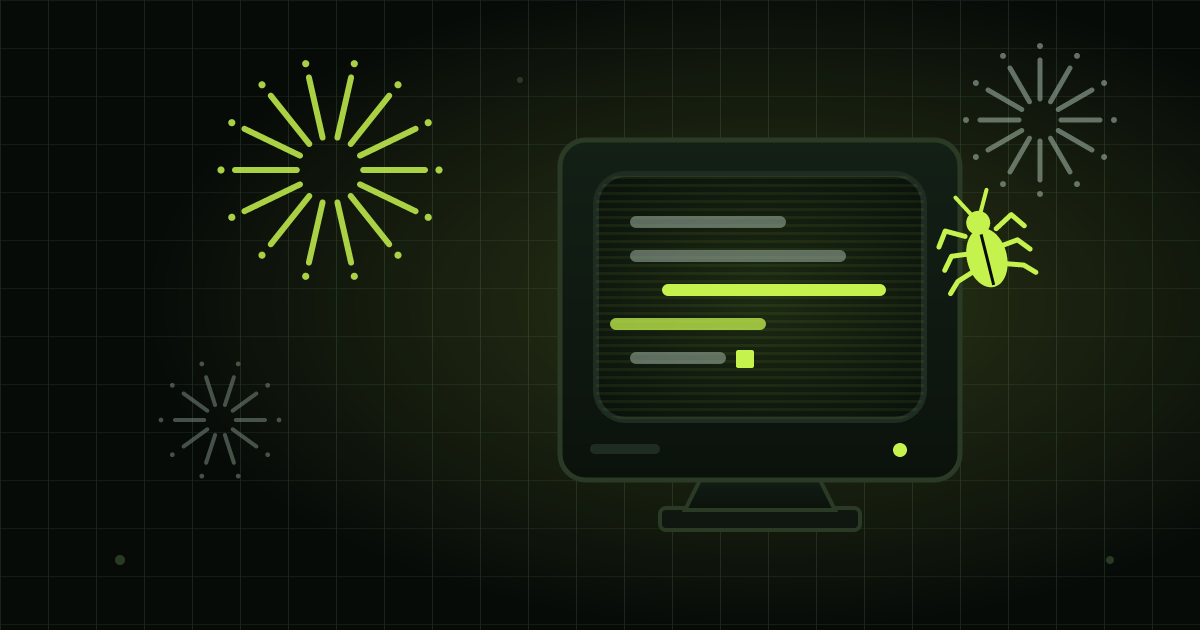
Remember New Year’s Eve 1999? Besides the countdown and the party, there was a question in the air: what if, at midnight, computers went crazy? Banks frozen, lights out, planes falling. The fear had a name: the millennium bug. Or Y2K, for “year 2000” (the K stands for “kilo”, a thousand).
Midnight came, and the world kept standing. That’s why many people remember the millennium bug as a big hoax. But the story is much more interesting: the problem was real, and the party was calm only because a lot of people spent years working to fix it.
A two-digit saving
“Bug” is the name for an error in a computer program. And this bug was born from a decision that, at the time, made perfect sense.
In the first computers, every bit of storage space was expensive. Memory was tiny and costly, and much data was recorded on punched cards, paper cards with 80 columns, each column holding one character. So programmers wrote the year using only its last two digits: “98” meant 1998, as the Smithsonian, the US network of museums, explains.
According to an EBSCO entry (EBSCO publishes reference works), dates in COBOL, a programming language widely used by banks and governments, followed a six-digit format (month, day and year). When IBM launched its System/360 family of computers in 1964, the two-digit year became the industry standard.
Nobody imagined those programs would still be running decades later. But they were.
The “00” problem
The math is simple. If the computer stores the year as “99”, it understands 1999. When the calendar turns, the year becomes “00”. And then? Does the computer understand 2000 or 1900?
For most systems, the answer would be 1900. And that would mess up any calculation that depended on a date: interest on an investment, a person’s age, a card’s expiration date, a bill’s due date. As computer scientist Nir Oren, from the University of Aberdeen, explains, the risk wasn’t just a wrong number on a screen: one error could trigger another, across power grids, phone networks and financial systems.
And the problem wasn’t limited to big computers. Medical equipment, elevators and climate control systems also had chips that handled dates, the Smithsonian notes.
The warning that took a while to catch on
The curious thing is that the warning came early. Robert Bemer, one of the creators of COBOL, advocated four-digit years and published warnings in 1971 and 1979, according to EBSCO. Almost nobody paid attention.
Things only heated up in the 1990s. On September 6, 1993, Canadian engineer Peter de Jager published an article in Computerworld magazine calling the turn of the century “Doomsday 2000”, according to SmarterMSP. He estimated the fix would cost tens of billions of dollars. He guessed too low.
By 1999, the bug was already showing up in real life. TV host Stewart Cheifet, of the show Computer Chronicles, received a credit card from a big gas station chain with an expiration date in the year 1000, the Smithsonian recounts.
A billion-dollar task force
Banks, companies and governments put together teams just for this. The job was to go through program after program, find every place that handled dates and switch the format to four digits. When that wasn’t possible, they used a trick: treat years “00” to “50” as 2000s and “51” to “99” as 1900s, explains Nir Oren. In devices where the error was in the chip itself, the only way out was to replace the equipment.
The consulting firm Gartner estimated the total cost at between 300 and 600 billion dollars, according to the Smithsonian. In the United States alone, it was about 100 billion, according to US Department of Commerce figures cited by EBSCO. In October 1998, the US even passed a law encouraging companies to share information about the issue, and in December that year the UN held an international conference on the bug.
In Brazil, where I live, the mood was the same. A 1998 internal bulletin from IBGE, the national statistics institute, Conexão IBGE, already described the “Millennium Bug” and said the institute’s IT department was inventorying every piece of equipment and software to gauge the size of the problem.
And at midnight?
No major catastrophe happened. According to EBSCO, more than 95% of the problems were fixed in time. What was left became anecdotes, and Mental Floss collected a few:
- At a video rental store in New York State, a customer was billed a late fee of over 91 thousand dollars: the computer thought the movie was 100 years overdue.
- A hospital in Denmark registered the country’s first baby of the millennium as if he were 100 years old.
- The US Naval Observatory website showed the date as “January 1, 19100” for less than an hour.
- American spy satellites sent unreadable data for almost three days. Ironically, the culprit was a fix made to avoid the bug.
Even the extra day of February 29, 2000 caused trouble: there were at least 250 small failures in 75 countries, according to EBSCO.
Overblown, or a job well done?
To this day, some people think it was all overblown. Many experts, like Nir Oren, say the opposite: nothing happened because a lot of people worked to make sure nothing happened. It’s the paradox of preventing problems: when the work is done well, it looks like there was never any danger.
And the story isn’t over. Many computers count time in seconds since January 1, 1970, and, in systems that store that count in a small space, the counter overflows in 2038, Nir Oren points out. The “00 to 50” trick also has an expiration date: 2050. In other words, the millennium bug has cousins, and someone will have to remember them in time. Preferably without waiting until 1999 again.