The "vague, but exciting" proposal that became the web
On November 12, 1990, two CERN researchers asked for help with a hypertext project. It was named the World Wide Web and changed everything.
You tap a link on your phone and, a second later, you’re on a page from another country. You jump to another one, and another, without thinking about how it gets there. That gesture has a birth certificate: a document handed in at a physics lab in Switzerland, which the boss read and found “vague”. Tomorrow, November 12, marks 36 years since that document became a formal plan and got the name we still type today: World Wide Web.
I started programming when I was 11 and, even so, it took me a while to understand something almost everyone mixes up. So let’s take it step by step.
The internet and the web are not the same thing
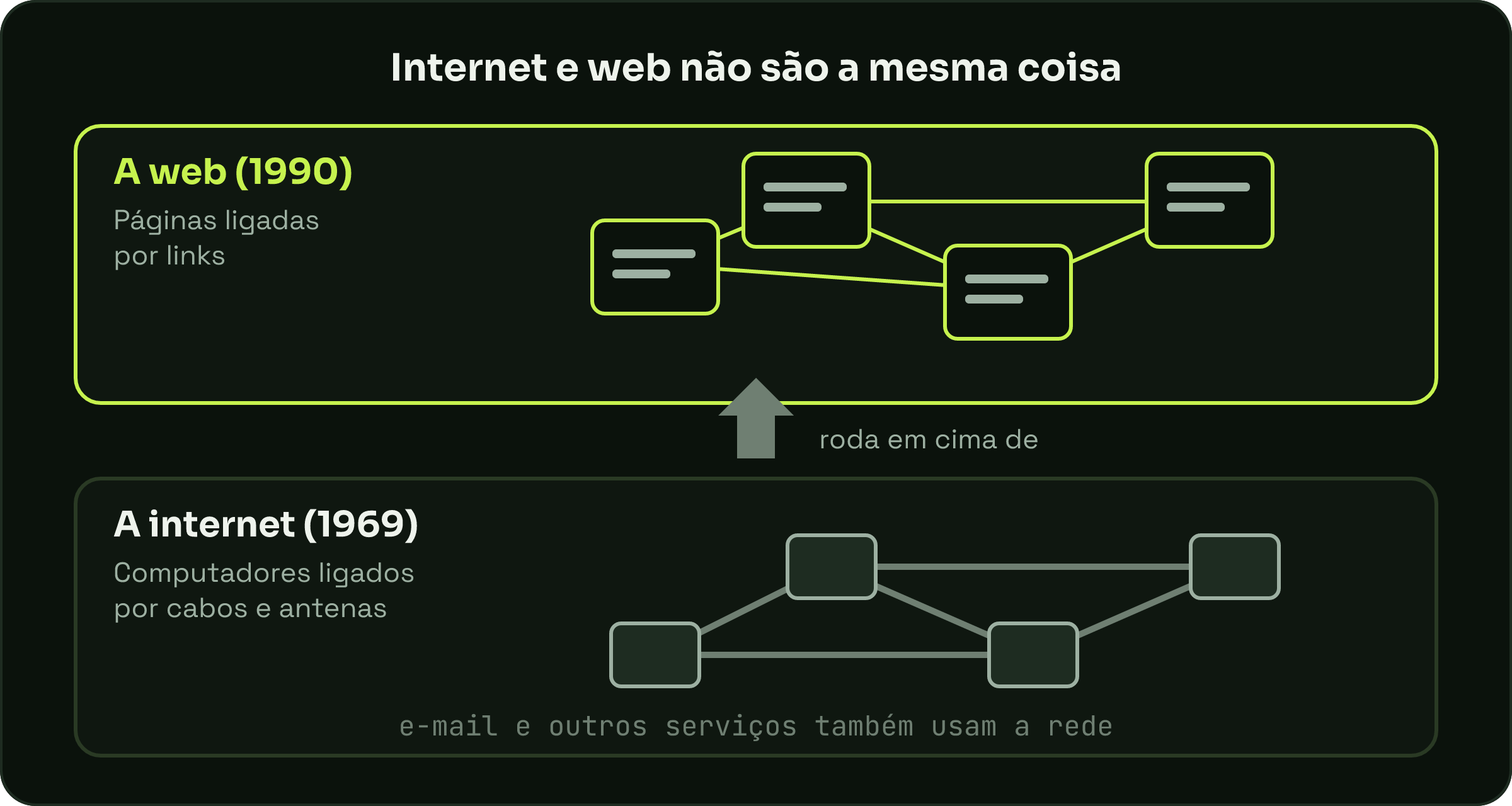
The internet is the network: cables, antennas and computers all over the world connected to each other, exchanging data. It’s older than the web. I told here how the internet’s first message crashed midway, back in 1969.
The web is something else: it’s the system of pages connected by links that runs on top of that network. Robert Cailliau, one of its creators, describes the web as something that relies on the internet’s naming scheme and treats the internet as the platform underneath it, in a text published by CERN. A simple comparison: the internet is the road; the web is one of the services that travel on it. Email, for example, is another.
The problem: a lab that kept losing information
CERN is the big European particle physics laboratory, on the border between Switzerland and France. A lot of people and a lot of information move through it, spread across different systems. The 1990 proposal, which we’ll get to in a moment, talks precisely about bringing together the information servers that already existed at the lab in a single place.
Tim Berners-Lee, who worked on software at the lab, had already played with that idea. According to the history kept by the W3C, the consortium that looks after web standards today, in 1980 he wrote a note-taking program called Enquire, in which one piece of information pointed to another.
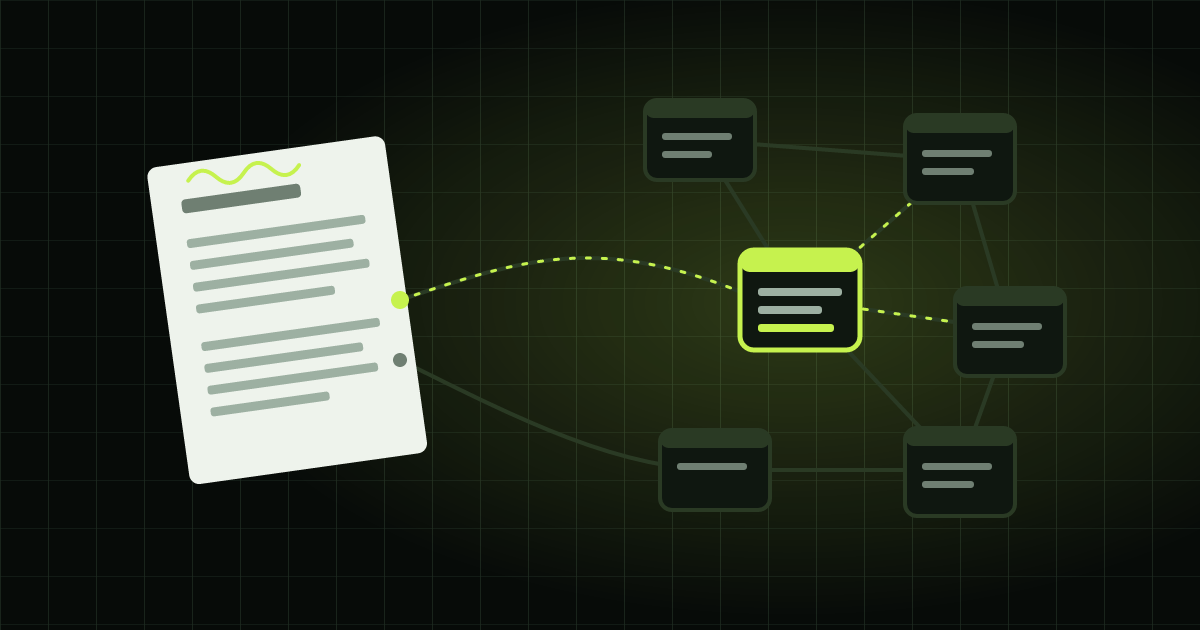
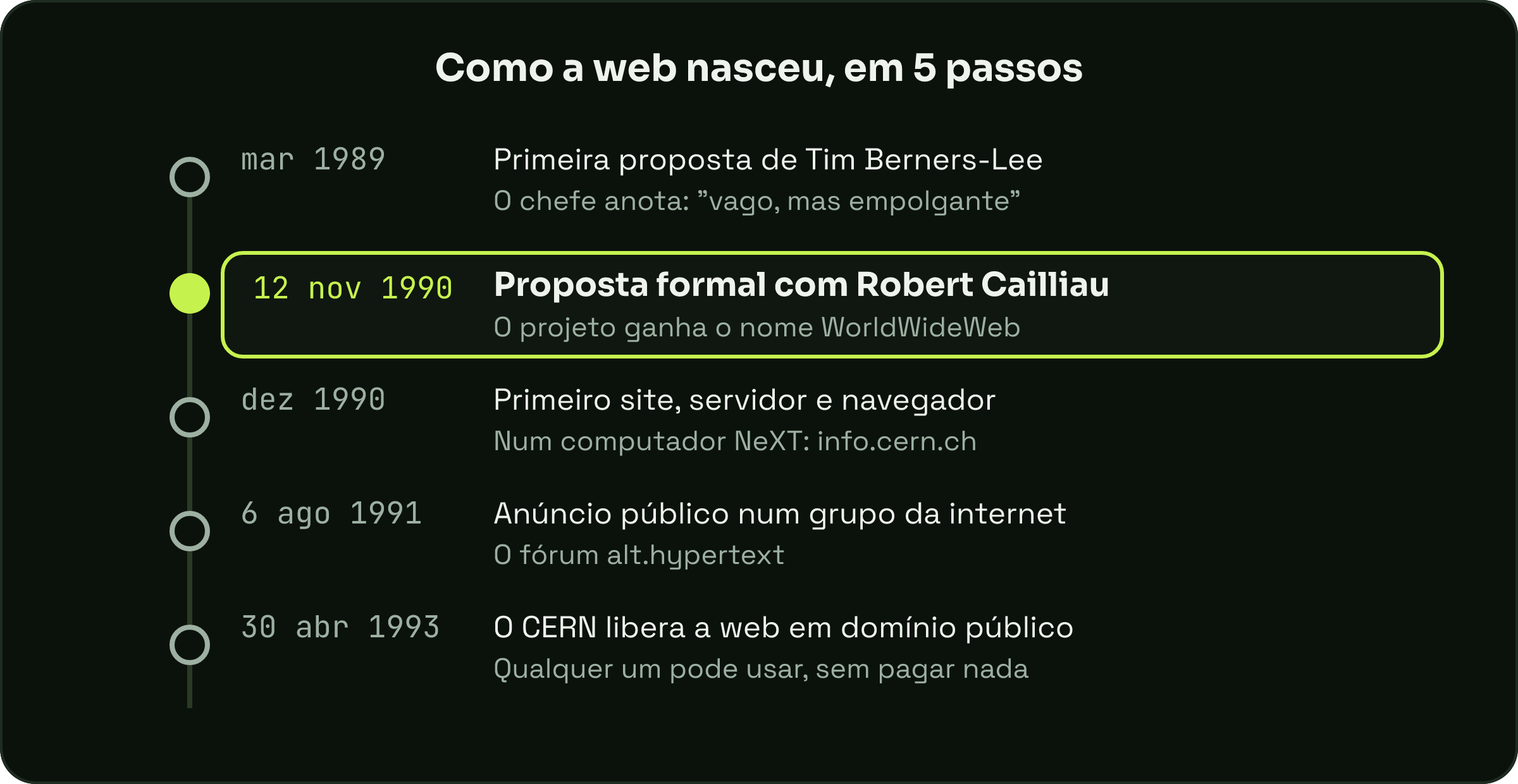
In March 1989, he handed his boss, Mike Sendall, a document called “Information Management: A Proposal”, describing a system to organize the lab’s information.
Sendall read it and wrote at the top of the page: “Vague, but exciting”. He didn’t approve it right away, but he didn’t shelve it either.
November 12, 1990: the plan gets a name
The idea spent some time maturing. In May 1990, Berners-Lee resubmitted the proposal with small tweaks, according to the web’s 30th anniversary site. According to the W3C, in September Sendall approved the purchase of a NeXT computer, and in October Berners-Lee started programming the first browser on it.
That’s when Robert Cailliau, a CERN colleague, came in as co-author. On November 12, 1990, the two signed “WorldWideWeb: Proposal for a HyperText Project”, the formal proposal. Hypertext is text with links: you click a word and land on another document.
The plan was modest: a first phase of 3 months and a second of another 3, with four software engineers and a programmer. Nobody promised to change the world; it was about organizing the lab’s information.
And the name almost ended up different. According to the W3C, World Wide Web beat options like Information Mesh, Mine of Information and Information Mine.
The world’s first website was about itself
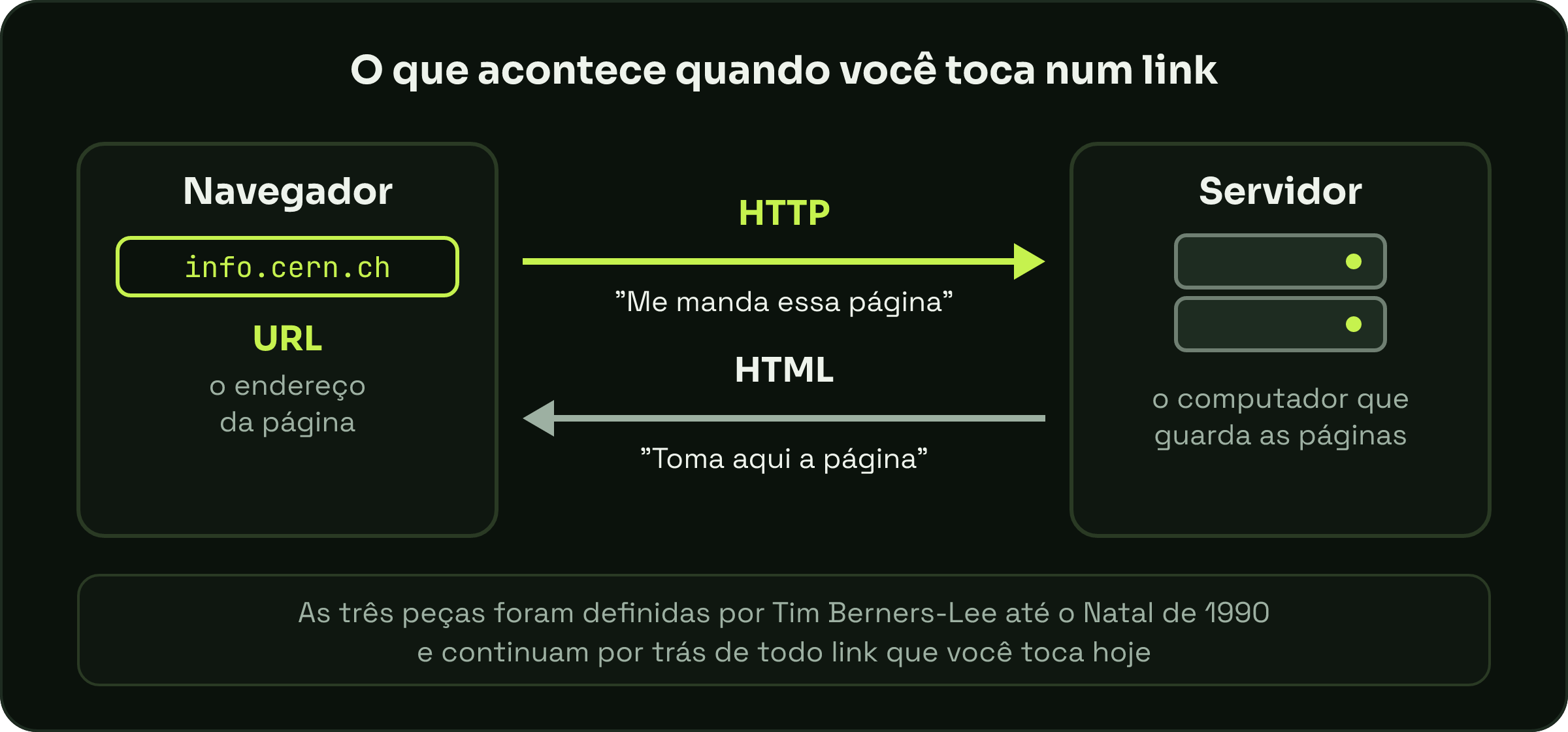
By Christmas 1990, Berners-Lee had defined the three pieces that make the web work and written the first browser (itself called WorldWideWeb) and the first server, according to CERN. A server is the computer that stores pages and delivers them to whoever asks.
The three pieces are:
- URL, the address of each page, like a house number;
- HTTP, the rules of the conversation between browser and server (“send me that page”, “here you go”);
- HTML, the language the page is written in, with its headings, text and links.
The web’s first server was that NeXT, at the address info.cern.ch. And the world’s first website was, guess what, about the project itself. In 2013, CERN started a project to restore that historic page.
From the lab to the world
On August 6, 1991, Berners-Lee announced the project in an internet discussion group about hypertext, alt.hypertext. In December of that year, the first server outside Europe went online at SLAC, a laboratory in the United States, according to CERN.
The decisive step came on April 30, 1993: CERN put the web software in the public domain. Anyone could use it, copy it and improve it, without paying anything. Cailliau recalls that the team even discussed charging royalties or starting a company, and chose to set it free.
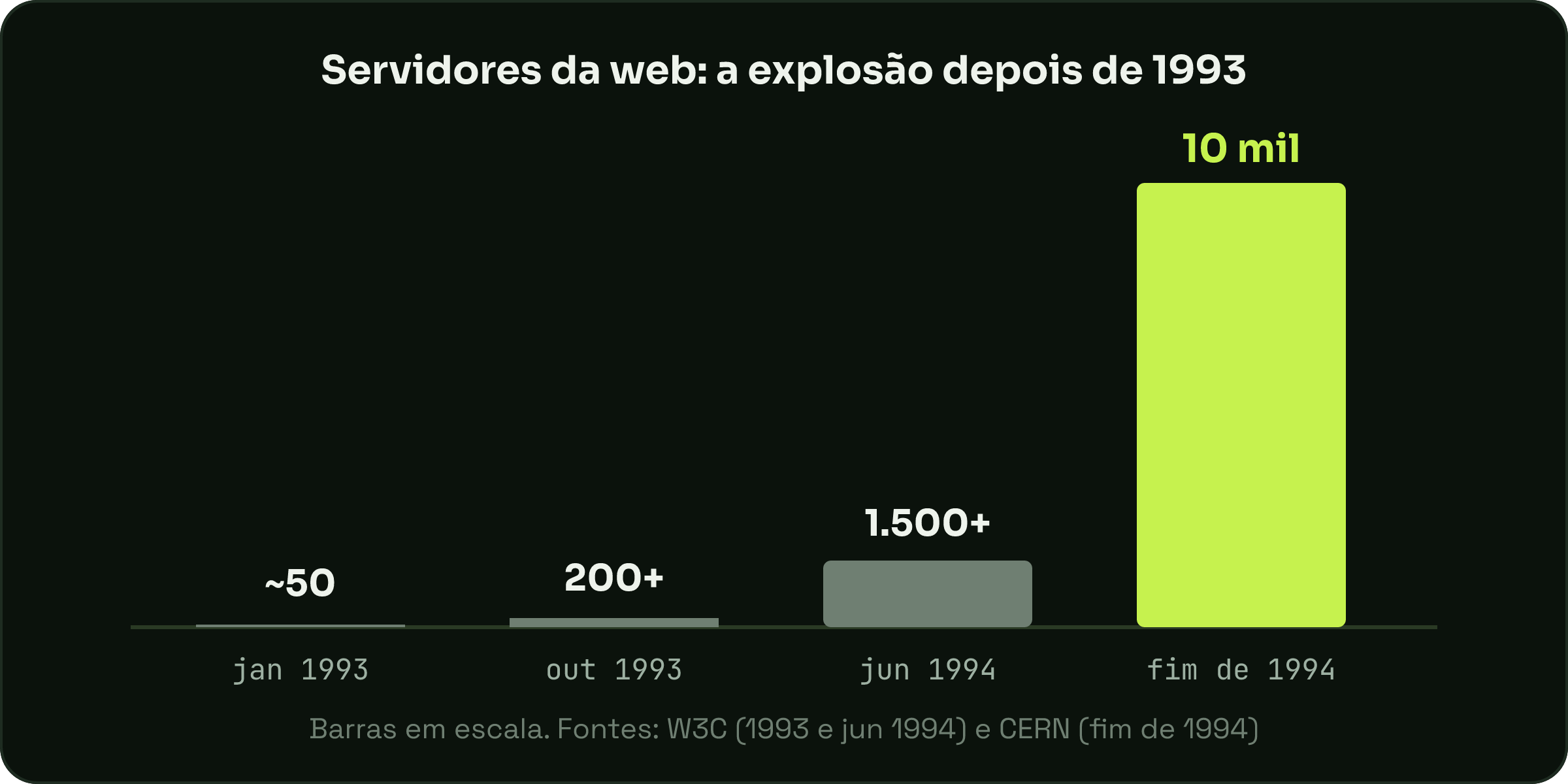
The effect shows in the numbers. The W3C list records about 50 known servers in January 1993 and more than 1,500 in June 1994. By the end of 1994, according to CERN, there were 10,000 servers and 10 million users.
What this has to do with you
A six-month plan to organize a lab’s paperwork became the place where we read the news, shop, study and argue in the comments. And almost none of the basics changed: when you tap a link, your phone still uses an address (URL), asks for the page following the HTTP rules and receives a text in HTML, just like in 1990.
Two lessons stand out. First: the web grew so fast because it was released for free; if every site had to pay for a license, the story would be different. Second: sometimes a good idea looks “vague” on paper. Luckily, the boss also found it exciting.